
Entering this season, Arsenal had every reason to expect to challenge for the Women's Super League title.
They signed plenty of star names, including England midfielder Georgia Stanway, Spain goalkeeper Misa Rodríguez, and Germany internationals Lisa Baum and Selina Cerci. On paper, they amassed arguably the deepest WSL squad ever. They looked ready to end their run of finishing as runners-up.
Then, Arsenal flopped.
After six WSL games, Arsenal have a single win; they've scored a paltry five goals -- only Charlton (three) have scored less -- and they find themselves in eighth place. All the while, Arsenal have looked disorganised in defence and toothless in attack.
Now, manager Renée Slegers finds herself under immense pressure, but is there a solution? Here are three tactical issues facing Slegers' Arsenal side and potential ways to fix them.
Issue: Concerning lack of goals
Goalscoring, or lack thereof, has been Arsenal's most fundamental issue this season. They have scored five goals from an xG total (expected goals) of 10.9. Only on one occasion have they managed to score more than one goal -- in a 4-2 defeat to Manchester City.
A look at Arsenal's underlying numbers shows some of the issues. Their xG total through the first six games last season (10.8) is almost identical. However, Arsenal have taken 121 shots so far this season (compared to 95 in the same period in 2025-26), but their xG total is much the same. There are also signs that selecting when to shoot is an issue: 36 of those 121 shots have been blocked by opposing defenders.
Slegers does have positives to take. Arsenal have managed to get the ball into the opposing penalty area more frequently this season, registering more touches and more passes into the box than last term.
Arsenal's goalscoring issues stem from Slegers' side being inefficient and too focused on crossing the ball into the box. In fact, the increase in passes into the box is almost exclusively due to the increase in crossing volume (Arsenal crossed the ball 21.1 times per game during this period last season; that has increased to 31.3 crosses per game this season).
Crossing the ball isn't inherently a bad strategy -- it is valuable if your attack has an aerial threat to make the most of it -- but Arsenal don't have an aerial advantage. The Gunners have attempted the most open-play crosses in the WSL this season (130), but among teams that have attempted more than 10 headed shots this season, they are the only side yet to score.
There are multiple layers to this problem. It could be down to feeling more pressure to score goals, as well as the fact that Arsenal often come up against teams who play deep against them.
The impact, though, is that Arsenal's attack has become predictable.
Solution: Create more angles of attack
Variety should be the name of the game for Slegers and her attacking staff. An attempt to drift away from crossing and instead build other angles of attack would make them harder to nullify.
The good news is that Arsenal's squad has the exact kind of quick, young, unpredictable players that can do that. Both Baum and reigning WSL Young Player of the Year Olivia Smith are capable of skilfully dribbling the ball forward and creating opportunities.
The pair should be encouraged to take on opposition defenders, beat them for pace and skill, win fouls and create scoring opportunities.
Issue: Caldentey at left wing and midfield imbalance
Slegers has preferred a 4-2-3-1 starting formation since taking over in September 2023, but figuring out how best to line up her uniquely deep squad has proven a challenge.
In response to an injury crisis last season, Arsenal relied on Kim Little and Mariona Caldentey to play out of position and fill in at the base of their midfield. This kept two of their most creative midfielders further from the opponent's goal and increased the creative load on striker Alessia Russo and the rest of the attack. The result? A lack of ideas in the final third.
Arsenal made big moves in the summer, raiding the German top flight and signing some talents such as Géraldine Reuteler, Stanway, Baum and Cerci.
But big squads come with big responsibilities. Arsenal are now spoilt for choice in some areas while barely covering others. For example, Arsenal replaced the outgoing left back Katie McCabe with Ona Batlle, who naturally plays on the right-hand side.
The arrival of Stanway was supposed to free up Little and Caldentey to play closer to the opposition goal. The 37-year-old manager has tried to incorporate Little, Caldentey and Stanway into the same starting XI, but it has forced Caldentey to play on the left wing rather than centrally.
It has left Arsenal looking imbalanced all over the pitch.
Caldentey is no stranger to being on the left wing -- it is where she played in her debut season at the club during which she won the WSL Player of the Season award. However, she had Frida Maanum in the attacking midfield role, which allowed her to drift deep inside to pick up the ball while left back McCabe provided width and Maanum filled in for her further up the pitch.
This season, with Stanway at the base of Arsenal's midfield, when Caldentey drifts inside it leaves the onus on the left back -- typically Batlle -- to provide width and attacking threat. When that threat isn't provided, opposing teams can risk leaving Arsenal's left flank more exposed and commit more players elsewhere on the pitch. Man City performed this tactic in their 4-2 win over Arsenal earlier this month.
In the sequence of play below, Caldentey can be seen operating as an attacking midfielder, abandoning her starting position on the left wing. The cascading effect of this forces left back Batlle to push up and provide width. However, it leaves massive gaps on the left side of their defence and needs a central midfielder to compensate for it, creating gaps in the middle.
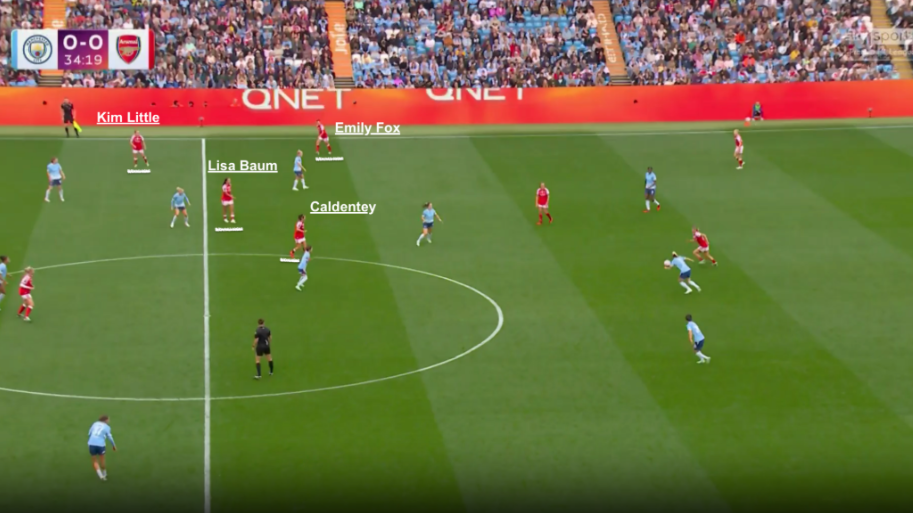 Credit: Sky Sports
Solution: Bench a star player
The good thing about having a deep squad is having options to choose from.
Arsenal could look to pick between Caldentey and Little in midfield and play an extra attacker instead of the other -- albeit, Caldentey's recent injury has eased that decision for Slegers.
Starting Smith on one flank would help Arsenal pin back opposition defences, as well as creating time and space for their midfielders to arrive into the penalty area.
Caldentey remains an amazing talent. With her on the pitch, Arsenal can create central overloads, but they should look to pair her with a centre forward who can consistently make runs in behind, or another midfielder who can crash the box, to benefit the team. Good options for those roles -- Stina Blackstenius, Maanum and Reuteler -- are already in their squad.
Correcting the balance of Arsenal's starting XI is a must.
Issue: Defensive gaps on the left-hand side
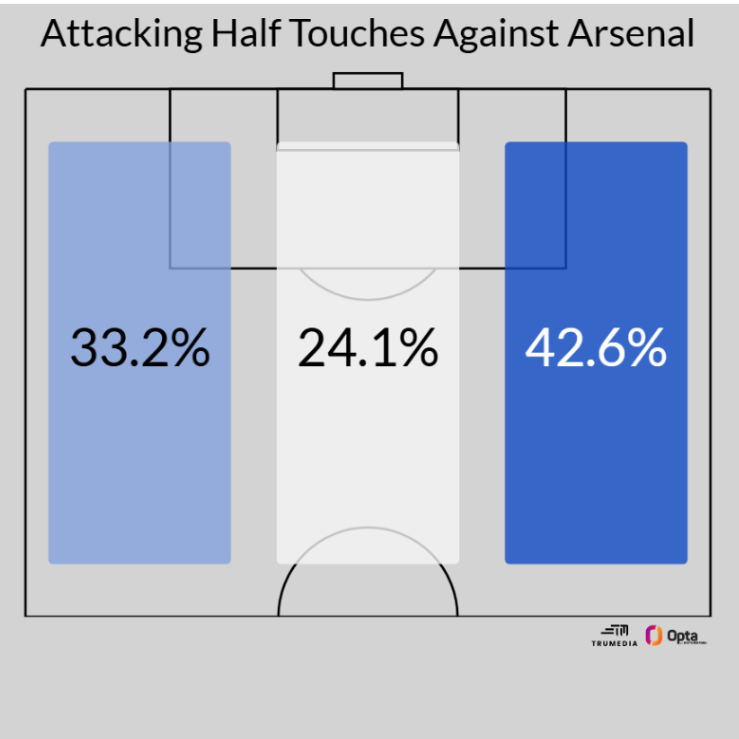
Arsenal's overload in central areas -- caused in part by Caledentey's frequent shift inside -- leaves gaps in wide areas, and opposing sides have exploited that, particularly on their left-hand side.
Opposition fullbacks and wingers have found space behind Arsenal's defensive line too often.
Arsenal have allowed 75.9% of their opponents' attacking touches down the flanks, and more than 50% of the opponent's penalty area entries have come from the opposition's right-hand side (67 out of 133 entries).
Solution: Start a natural left winger
There is a saying that attack is the best form of defence, but in this instance it could be right. The solution for balancing their midfield by starting a more natural left winger is the same for fixing their defensive left-hand side.
By starting a true winger, Arsenal could pin back the opposition right back, denying them the freedom to roam forward and create an overload of players on that side.