

If you're a soccer fan but have found yourself watching a match and yearning for the added chaos of another team being thrown into the action, then do we have the perfect sport for you.
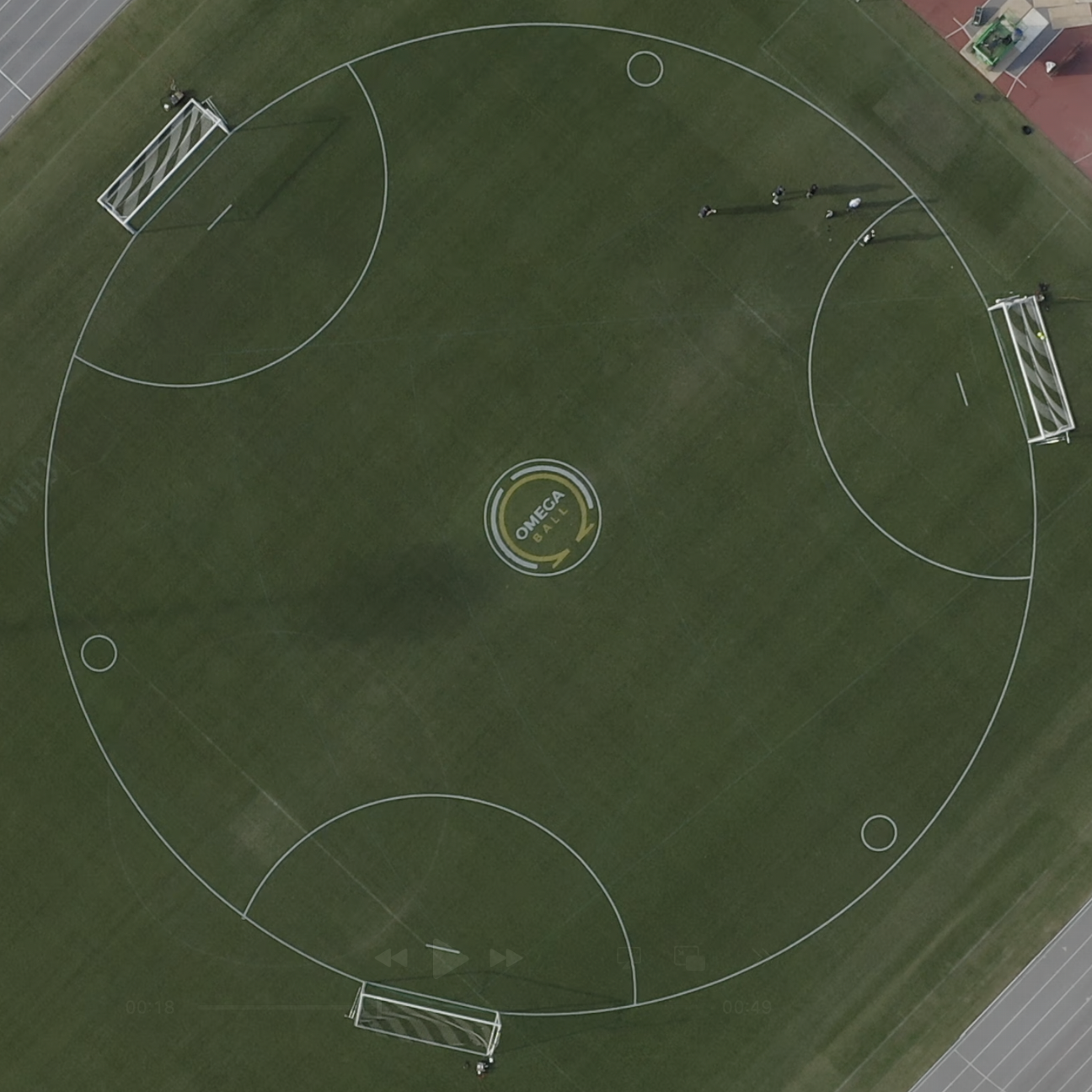
OmegaBall is instantly recognizable as a variation of association football, but the ante has definitely been upped by pitting three teams against each other at the same time, all competing at breakneck speed on a head-spinning circular pitch.
And, unlike the 11-a-side game, there aren't even any offsides or corner kicks to slow down the action. In fact, finding a way to get rid of the offside rule was a key driver in the devising of the game.
- ESPN8: The Ocho -- 2026 OmegaBall Men's Championship, 8/8, 4 p.m. ET
- Hate extra time and penalties? Meet the man on a mission to replace them
- Have World Cup withdrawal? Enjoy the greatest kits in tournament history
"I thought, 'What if you got rid of offside?'" Anthony Dittmann, one of the creators of OmegaBall, tells ESPN. "'Would I change the game? Would it make it more exciting?' Almost in my own naivety about the rule itself.
"But I thought, 'What if the game was more circular, less linear? Would that negate the need for the offside role?'"
How does a three-sided soccer game work?
An OmegaBall game has three teams of five players (four outfielders and a goalkeeper) competing on a round field that measures 60 yards in diameter. Three goals are positioned around the circumference of the pitch, spaced roughly 60 yards apart from one another and 30 yards from the center spot. Each team is then tasked with protecting one goal while attempting to score in the other two.
Teams score one point for each goal they score in either of their opponents' nets. If an own goal is scored, that team receives a one-point deduction. When a goal is scored, play must be resumed by the conceding goalkeeper within five seconds, often leading to quick counterattacks while opposing teams are still out of shape. There are also "vulture goals," when one team attacks another's goal but has its possession robbed by the third team, allowing that team to score instead.
Strikers will be glad to know that there is no offside rule and that goal-hanging is not only admissible, but positively encouraged. If the ball goes out of bounds, play resumes with a kick-in (called a "Delta Kick") from the closest touchline marker.
The winner is the team with the most goals/points scored at the end of the game. Games last 39 minutes in total, consisting of three 13-minute periods with two short breaks in between.
As far as on-field officiating goes, most games require just one referee and one scorekeeper, though it's recommended that two referees are deployed along with one scorekeeper and three line judges for championship games. As a general rule, a lot of goals are scored over the course of a game, so it's necessary to keep a careful tally of the (three-way) scoreline.
How was OmegaBall invented?
The grand old game of association football has been tinkered with ever since the Laws of the Game were first codified in 1863. Since then, many offshoots have been trialed -- some more successfully than others. From five-a-side to futsal to swamp football (which is exactly what it sounds like), the world's most watched sport has been used as the basis for countless spin-offs and reinterpretations.
OmegaBall isn't the first three-sided football offshoot to have been conceived. Exhibition games on a hexagonal pitch were trialed by students in Glasgow, Scotland, in the early 1990s. There have even been two Three-Sided Football (3SF) World Cups, hosted by Sweden in 2014 and Germany in 2017.
But, on the other side of the Atlantic, OmegaBall has been taking off ever since the first match took place in Irvine, California, in 2020. The sport was devised by Dittmann in conjunction with friends and former ESPN colleagues, Bob Funk and Jamie Hemann.
Led by Dittmann, initial test games took place in 2020 in Oklahoma, where Bob owned a soccer facility that was lying dormant due to the COVID-19 pandemic. With the professional team unable to play, the players and coaches were also on hand to assist as OmegaBall was put through its paces for the first time.
"Three months later, we did it with a college team [and got the] same result," Dittman tells ESPN. "We had a hoot. Really, no one had anything bad to say about that because we would do surveys postmatch and everyone really liked it."
Things began to gather momentum and soon enough OmegaBall games were staging small-scale, televised tournaments at their new home base at a sports campus in Southern California.
"We had a small tournament in Southern California in 2022, just collecting a rag-tag bunch of players," Dittman says. "[We had] ex-Division I soccer players, some ex-pros, and a couple of national team players from other countries who aren't on their national teams anymore.
"We did a tournament and we've really kind of caught fire since."
The initial idea was to devise a new take on the sport of American football, but soon the trio turned its sight to soccer. The addition of a third team to the game seemed like a surefire method of adding extra action -- and chaos -- to the sporting spectacle and thus, OmegaBall was born.
Ditmann describes himself as a casual fan of soccer, only to the extent that he might catch the odd game on TV. He began to question why soccer hadn't quite grabbed him as a spectacle, and soon some rule tweaks began to formulate in his mind.
"One thing that really popped in my head was [the offside law]," he says. "Soccer is a low-scoring game to begin with. [That was] the obvious thing, certainly from an American perspective, as to why we may not love it."
Offside was removed from the equation, and this led to further exploration of how to transform the linear flow of a traditional two-sided soccer game into a more free-flowing contest. A circular pitch was devised with the addition of a third team to help further alleviate the natural "north to south" flow of a normal football match.
"We began with eight players on each team and we were like, 'Oof, that was a lot,'" Dittmann says. "And then we went to seven players: still too much. Six players: still too much.
"Then once we got to five, we were like, 'Okay, this is good.' It seemed to work well. I think that was really the only thing that we manipulated over time."
The inaugural OmegaBall Championship was held in California in 2022, and several tournaments have taken place since with both men's and women's teams taking part in a series of invitational competitions and challenges, many with prize money on the line. The most recent event saw the delightfully named Bumpy Pitch FC run out as winners at the March Mayhem championship held at Dignity Health Sports Park in Carson, California, while the women's title was secured by United City FC.
Now OmegaBall has spread across the world with matches taking place in Europe (Spain and Germany), Africa (Nigeria and South Africa) and Asia (India).