
The UEFA Women's Champions League is back!
The first round of league phase matches have taken place, and there is plenty to mull over. Barcelona and OL Lyonnes romped to big victories, but every other game was closely fought.
Chelsea could only manage a 1-0 win over European debutants Austria Wien despite taking an early lead; Arsenal were similarly blunt in attack, in what is becoming a worrying trend for them, before a late penalty gave them a 1-0 win over minnows HB Køge; and Manchester City were held to a 2-2 draw with Bayern Munich with their first goal the source of some debate.
There were also eye-catching draws between Real Madrid and Paris Saint-Germain, as well as OH Leuven and Roma.
But what do ESPN reporters Emily Keogh, Alex Kirkland and Shubi Arun make of it all, with some VAR insight from Andy Davies. Here are some of our burning questions.
Arsenal are still struggling to score goals. Why?
Arun: The Arsenal forward line is undergoing a crisis of confidence, and it feels like a mental block has developed. The growing discourse around their attacking woes -- with only three goals in four matches this season -- has clearly reached the players, and the anxiety in the stands is transmitting to them.
You could sense the relief around Meadow Park when Chloe Kelly volleyed into the bottom corner early on against HB Køge -- Arsenal defender Steph Catley alluded to that feeling in her post-match interview on Disney+ too -- but when VAR disallowed the strike, all their anxieties immediately returned.
The fact that Arsenal had just two shots on goal during the game points to a forward line that lacks belief in their abilities. Germany forward Selina Cerci was the only one who looked unencumbered by pressure, and it was her audacity in the box that won Arsenal the 93rd-minute penalty that Mariona Caldentey converted to win them the game.
Maybe it isn't a coincidence that the Gunners' lackluster performances this season have come at home. Their next three matches across competitions are all away, and that might actually work in their favor.
Keogh: Arsenal's goal-scoring problems stem from an insistence on playing their best attacker in the wrong position. They have one of the best strikers in the world in England international Alessia Russo, yet manager Renee Slegers has continued to deploy her in midfield to accommodate Stina Blackstenius up front.
It is a tactical experiment that has seldom worked in Arsenal's favor and has prevented Russo from developing the consistency expected of a traditional No. 9. Would Manchester City's Khadija "Bunny" Shaw be as effective if she were constantly being moved out of her natural position? No.
Arsenal's system is asking one of their key attackers to operate away from the area where she is most dangerous, and that is inevitably having an impact. When Arsenal's wingers then send crosses into the box, Russo is not always there to finish them, and it has become a predictable pattern that opponents can anticipate.
Playing Russo in her best and preferred position would not magically solve all of Arsenal's attacking problems -- after all her teammates are also lacking clinical finishing -- but it would address some of the tactical issues limiting the attack.
Nearly every game was decided by just a single goal. Will this year's UWCL be more competitive?
Kirkland: It's too early to say, and we should wait until we've got more evidence than just one matchday before drawing any sweeping conclusions, but it looks like it might be. That's good news for the competition's overall quality, even if it might mean we get to enjoy fewer goals.
I think it's detrimental to the image of what the Champions League ought to be -- the best teams facing off in high-quality games -- if we're seeing too many matches being won by five, six or seven goals.
Last season we saw too much of that: just look at Matchday 1 in 2025-26, when 39 goals were scored, which included Barcelona 7-1 Bayern Munich, Real Madrid 6-2 Roma and Atletico Madrid 6-0 St. Polten. You'll always get some high-scoring outliers, and that's fine, especially when teams like OL Lyonnes and Barça are involved, but too many undermine what the Champions League is supposed to be all about.
Let's see if the largely tighter scorelines continue, or if it's just a coincidence.
Keogh: Since the introduction of the Swiss format, the competition has become tighter. The Champions League is no longer as predictable or easy for Europe's longstanding juggernauts as it was under the traditional group-stage format.
But there is also something to be said for the way teams, particularly those from the Women's Super League -- widely regarded as one of the strongest leagues in the world -- have struggled in Matchday 1.
Chelsea were forced to withstand sustained pressure from a dominant Austria Wien attack, while Arsenal's profligacy meant they had to wait until late to break down HB Køge. Manchester City needed a gutsy performance to rescue a 2-2 draw against Bayern.
Elsewhere, teams such as Roma and OH Leuven are growing in confidence and building on their experience in European competition. Maybe the gap between the established powers and the rest is beginning to close. Even Paris FC stunned Barcelona by taking a lead inside five minutes.
The result is a competition that feels increasingly open. The late drama, end-to-end performances and tight scorelines are reflective of a campaign that will stretch these teams and force even the best of sides to rethink their strategy.
Should Man City's first goal have stood?
Keogh: Manchester City's first-half equalizer came amid a bizarre set of circumstances. Trailing 2-0, City defender Kerstin Casparij darted down the right flank as Bayern's Franziska Kett chased her. However, a flare had been thrown onto the pitch to the right of the penalty box. Casparij delivered her cross anyway, and the attack eventually found the back of the net through Beth Mead.
Debate has raged since over whether the goal should have stood.
According to a German media report, the flares had allegedly been launched from outside the stadium and were connected to a protest by disgruntled supporters of local side SpVgg Unterhaching. Their anger stems from Bayern Munich's purchase of Unterhaching's 15,000-capacity stadium, which has now become the home of Bayern's women's team and will host their Champions League fixtures this season. Unterhaching's men's side, meanwhile, will continue to play at the ground as tenants.
The initial reaction from spectators inside the ground was relatively muted. There was no immediate sense of panic, with most supporters appearing more concerned with the match itself than the flares. That changed, however, when the referee opted not to stop play and subsequently allowed Manchester City's goal to stand. The decision sparked a much stronger reaction from the crowd than the flares themselves.
The stadium, which was somewhat sparsely populated, suddenly became considerably louder. German supporters booed, shouted and jeered at both Manchester City and the referee.
For several moments, the atmosphere became increasingly hostile, with the crowd seemingly united in its belief that play should have been stopped. At half-time, Bayern manager José Barcala could be seen shaking his head and speaking animatedly to his coaching staff, seemingly still frustrated by the decision to allow the goal to stand.
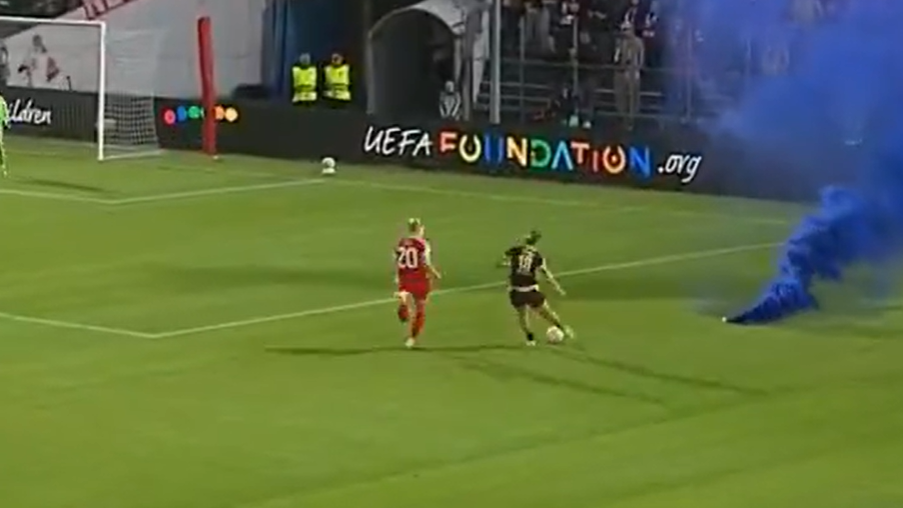
Davies: This was a poor piece of officiating by Spanish referee Olatz Rivera Olmedo and her team, and it is difficult to understand what the rationale was in this moment to allow play to continue. Ultimately, the referee must take responsibility for the safety of all players and officials on the pitch in this type of situation.
In law, specifically Section 2 of Article 6 in UEFA's Safety and Security Regulations, if a flare lands on the pitch then play must be stopped and dealt with by stadium safety team.
However, Law 5 in IFAB's Laws of the Game under the section "outside interference" says that if a flare lands in an area that doesn't impact play or is not an immediate danger to players and officials then it's OK to finish the phase of play. The context to each situation is at the referee's discretion.
In this situation, the flare clearly impacts play given it is within a few yards of the ball and both attacking and defending players. This must be deemed dangerous and play should have been stopped the moment the flare had landed, so City's goal wouldn't have happened.
What stood out to you on Matchday 1?
Kirkland: For me, it was Felicia Schröder's performance for Real Madrid's 1-1 draw with PSG. It was the first time I'd seen the teenager play live, in person, and it was quite something.
There are certain players whose qualities are always obvious, but even more evident when you get to watch them up close. Her display would ultimately prove frustrating, a string of really clear missed chances costing Madrid the three points, but they were also chances she'd largely made herself.
There was a lot of excitement around Schröder's signing this summer, and without getting too carried away, I'm pretty convinced it was justified. She could become a superstar, and being paired with Linda Caicedo will be a lot of fun to watch.
Will Schröder's addition be enough for Madrid to go beyond the quarterfinals this time? She'll have to improve her finishing first.
Arun: Austria Wien caught the eye with their spirited performance against Chelsea. When midfielder Wieke Kaptein put the Blues ahead early, you feared it would be a long night for the Champions League debutants. Far from capitulating, they remained resolute and took the battle to Chelsea.
Their physicality shone, and, in the second half, they upped their attacking intensity. They racked up more shots (15) than Chelsea and matched them for shots on target (6). Striker Modesta Uka was a lively presence up front and hit the post late on with a superb effort. Chelsea were lucky to come away with a win, but they won't be the only side to be troubled by this Austria Wien side.
Keogh: It feels as though OL Lyonnes manager Jonatan Giráldez has finally figured out his best XI and, more importantly, how to maximize the wealth of individual quality at his disposal within the same team.
Lyonnes boast one of the strongest squads in Europe, packed with international talent across the pitch. Yet that quality did not always translate last season. At times, the team looked disjointed, muddled, and unsure of how to make all of its individual pieces work together.
Much of Giráldez's first season in charge was spent searching for a way to harness that talent within a cohesive, well-structured system. There were occasions last term, like in the final in Oslo and in the first leg semifinal against Arsenal, when it did not look like this team knew how to play together.
But following a comprehensive 8-0 victory over Servette and an impressive start to their French league campaign, in which they've scored 22 goals in three games, there are signs that Giráldez may have finally found the formula.
The challenge was never a lack of talent but finding a structure that could bring the best out of players such as Melchie Dumornay, Lily Yohannes, Ada Hegerberg and Marie-Antoinette Katoto on the pitch at the same time. Early evidence suggests Giráldez is beginning to do exactly that, and that should be worrying for the rest of the European contenders.