

Unlike every major American sport, we rarely talk about who the best soccer player is.
And, well, it's been a long time since we've even had to. The answer was almost always Lionel Messi. Heck, it still might be Lionel Messi, too. And in the brief moments when it wasn't Messi, the answer was always Cristiano Ronaldo.
Of course, they both left the top level of the game a number of years ago. But rather than zeroing in on who has filled the resulting vacuum, we've asked a slightly different question: Who should win the Ballon d'Or?
And that's not quite the same thing. As the award's own website states: "The Ballon d'Or™ is awarded based on three essential pillars: individual performance, team achievements, and class combined with fair play."
We'll ignore the last part -- what is "class combined with fair play" even supposed to mean? -- but this criteria means that the award goes to the best individual player who has won the most team trophies. You could score 40 Premier League goals for a team that would've otherwise been relegated -- you'd stand no chance of winning the Ballon d'Or because your team isn't, say, owned by a sovereign-wealth fund.
But if we take a step back and think about who the best player in the world really is, the answer seems less clear than it has been in a long time. Your answer, in a sense, doubles as your own little philosophical statement about the sport:
How much do you value goals? How important is domestic play versus the Champions League? Is per-minute performance more important than sum-total contributions? What about work rate? Off-ball movement? League quality? Does the international game matter to you? Could a goalkeeper be the best player in the world? Perhaps you even understand what "class combined with fair play" actually means?
While the worst versions of these conversations devolve into people yelling at each other on the radio and someone eventually saying something like, "Lewis Dunk would have at least one Ballon d'Or if he played for Bayern Munich," I believe we can talk about these things in a way that not only raises up all of the players involved but provides some insight as to how the game works today.
So, throughout this season, I'm going to constantly update who I think the 10 best players in the world are. This is the first edition of ESPN's 10 Best List, a global look at the top players right now.
What does 'best' even mean?
In baseball, they have wins above replacement -- a catch-all metric that evaluates everything players do and converts it into the currency of wins. In American football, it's impossible for someone other than the quarterback to actually be the best player in the sport. And in basketball, there are so few players and so many substitutions that it's way easier to connect player performance directly to winning.
In soccer, we don't have any of that -- and we probably never will. There are numbers I can point to, but none of them provide definitive proof, nothing is an argument-ender. Unlike in the Messi era, I can't point to every different number and say, "See how the same guy is at the top of every list?"
Even with the numbers we have, the average player has possession of the ball for about three minutes every game. What he's able to do on the field is, in large part, determined by what everyone else on the field is able to do. And then there's the problem of where they do it.
The Champions League allows for some cross-pollination between the various European leagues, but the games are rare and provide such a tiny sample. Domestic play gives us the most consistent chunk of matches, but how do you evaluate the performance of a player on Bayern Munich vs. someone on Manchester United?
We know that Bayern are way, way better than the rest of the Bundesliga -- look at the results, look at the cost of the various rosters -- and we know that the Premier League is the most competitive league in the world, top to bottom. Again: look at the results, and look at the costs of the rosters.
But it's not like Bayern could just sign anyone and that player would immediately be a superstar. The reason Bayern are so much better than the rest of Germany is that their players are all really good.
All of this confounds the question, so rather than trying to give you a quantified, consistent criteria for my rankings, I'll tell you what I mean by "best."
In short: who contributes the most to winning?
Everything a player does on the field either increases, decreases, or has no effect on the probability of their team winning a given match.
The problem is that we don't know how much that off-ball run was worth -- especially if the pass never even got played. We don't know how much value to give a defender who is so rangy that he allows his manager to select more aggressive attackers in all of the other lineup slots. If a forward scores a ton of goals but never defends or creates for his teammates, then he's probably providing less value than those goals suggest -- but how much less?
I keep asking the questions because I don't have good, clear answers. But the simplest way to think about how I'm picking my top 10 is like this: If you added this player to an average round-of-16 Champions League team, how much more likely would they be to win the tournament?
With that, here is the first 10 Best List of the 2026-27 season.


10. Declan Rice, midfielder, Arsenal
Until someone can prove otherwise, I operate from the assumption that the best attackers -- wingers and strikers -- tend to be the most valuable players. That doesn't mean that the best player in the world can't play another position, but rather that most of the best players will be attackers.
It's a low-scoring sport, and scoring and creating goals is really hard because it all occurs in the most crowded area of the field. Midfielders, unlike forwards, have a much wider margin for error in everything they do, and while defenders are attempting to negate the attackers in the same high-value area of the field, the average successful defense play doesn't require anywhere near the same level of precision required on average from attackers.
So, to make this list, a player at another position needs to do some combination of the following: be a lot better than the next-best player at his position, contribute some amount of offensive value, or provide tactical and roster flexibility. I wouldn't say the first part is true of Rice, but he's the most complete midfielder in the world.
Not only can Rice play multiple positions in the midfield and contribute defensively, in buildup, and around the box, but he's also just huge, so there's no physical vulnerability you might have to account for with a player like Vitinha or Pedri.
I'd probably have William Saliba in the top 10 -- the best center back in the world -- but he's going to be out for a while with his back injury.

9. Vinícius Júnior, winger, Real Madrid
When I wrote about the Ballon d'Or race last year, I came up with a number to quantify overall attacking performance. We'll call it adjusted attacking contribution. It's a combination of non-penalty goals, adjusted penalty goals (worth 0.21 goals because the average penalty is converted 79% of the time), and expected possession value. The latter is the total of how all of a player's non-shot, on-ball actions increased his team's chances of scoring.
For last season, the list looks pretty close to a list of the best attackers in the world.
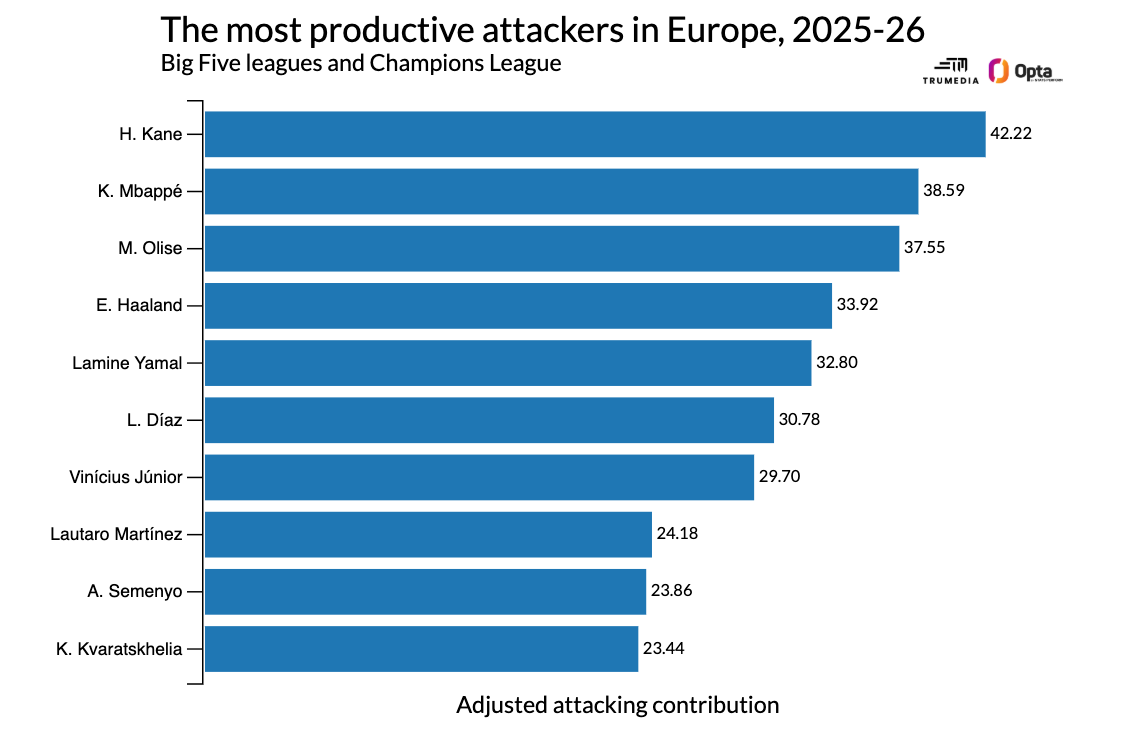
I dropped Vini one spot from his ranking on that list because, as we'll get to, the two-time defending Champions League winners defy any kind of standard analysis.

8. Julián Álvarez, forward, Atletico Madrid
Álvarez landed 12th on the attacking contribution list, but I bumped him up to eighth because, well, he started over Lautaro Martínez for Argentina, because LaLiga is a tougher environment than Serie A, and because he did it while also running himself into the ground for coach Diego Simeone.
Per Stats Perform, Álvarez applied pressure 76 times per 90 minutes last season. In that top 10 list pictured above? No one has more than 53.
7. Kylian Mbappé, forward, Real Madrid
Mbappé is the anti-Álvarez. He applied 30.1 pressures last season -- the lowest number of any forward in Europe's Big Five top leagues who played at least 900 minutes last season.
6. Erling Haaland, forward, Manchester City
Haaland ranked fourth in overall attacking contribution despite averaging just 22 touches per game. That's the lowest number of touches among the top 100 players -- by far.
There are two ways to look at this: (1) He's easily the most efficient player in the world, or (2) He's only contributing to one phase of the game, so he's requiring more contributions from his teammates than anyone else on this list.
The first point is definitely true. When Haaland touches the ball, it's more likely to lead to a goal being scored than anyone else in the world, and it's not close. As for the second: That he was basically just as productive for underdog Norway this summer as he has been for Manchester City suggests maybe he's not as reliant on world-class teammates as it seems.
He's amazing -- high-level analysis! -- and he could easily be No. 1 on this list. He's the most limited player on this list, but he's also better than anyone else in the world at the most important thing in the sport: scoring goals.

5. Michael Olise, attacking midfielder, Bayern Munich
If all things were equal, I'd have Olise at the top of the list.
He led all players last season in expected possession value, he pressed like mad, and he also attempted nearly four shots per game. Olise took 80-plus touches every game last season, and only one other player on this list came even close to that number. (Hint: It's the guy who came in at No. 3 below -- he was barely above 70.)
Pretty much every great team of the past 20 years had at least one high-usage winger who did everything: ball progression, chance creation and goal scoring. It's easier to get them the ball in wider areas than a traditional playmaker who is camped out in the middle, but it's harder to impact the game when you're farther away from the goal.
The players who can do it, though, are basically a cheat code. You don't have to worry about executing complex positional rotations or possession patterns or whatever -- you just have to get the ball to your winger, over and over again.
So why isn't Olise No. 1 on this list? Bayern's wage bill is bigger than the next two Bundesliga wage bills -- combined. Plus, we know that the wide-open Bundesliga inflates attacking statistics, and we also don't know that Olise is even the best attacker on his own team.
But, really, we're one dominant Champions League run away from Olise winning the Ballon d'Or.
4. Harry Kane, forward, Bayern Munich
According to prediction markets, Kane is the odds-on favorite to win the Ballon d'Or. And if he does win, it would be so unprecedented that it would prompt a number of existential questions. Most urgently: What does it say about our collective future when a man who wears Skechers cleats is named the best soccer player in the world?
In three years with Bayern, Kane is averaging 1.14 non-penalty goals+assists per 90 minutes, which is better than what Robert Lewandowski did in Germany and just 0.05 off of what Cristiano Ronaldo did with Real Madrid. Different contexts, sure, but Kane's late-career transformation into the most complete center forward in the world has me reconsidering everything I thought we knew about how players age.
3. Khvicha Kvaratskhelia, winger, Paris Saint-Germain
I don't have a great answer for how to assess Paris Saint-Germain players. PSG are so much richer and better than everyone else in Ligue 1 that they've basically been able to treat the soccer season like they're an NBA team. The regular season doesn't really even matter -- they just rest all of their stars and turn it on in the spring.
Kvara played only about half of the available minutes in Ligue 1 last season. Across domestic and European play, Vinicius Junior played nearly 1,500 more minutes last year. And not only is every equivalent Premier League game much tougher than what you see in Ligue 1, but Manchester City's and Arsenal's players all had to max out their domestic minutes because they were in a seasonlong title race.
And yet, despite the limited minutes load, the Georgian winger still landed in the top 10 of the attacking-contribution rankings. Plus, PSG's transformation into the best team in the world coincides pretty much directly with Kvara's arrival from Napoli in January 2025. He's close to the perfect winger: a physical machine who will run himself into the ground off the ball and ruin the lives of opposing fullbacks. You can play however you want with him in your team, and we've seen him carry Napoli to a title and put PSG over the top.
Sure, he benefits from playing PSG's cushy schedule, but they wouldn't swap him for any other player in the world.

2. Lamine Yamal, winger, Barcelona
We all sort of collectively decided that Yamal was one of the best players, if not the best player, in the world a year ago. But you can't be the best player in the world when you're a winger who scored nine goals and added 13 assists over a full season.
Those numbers are great -- unprecedented, especially, when you're a teenager -- but this is an era where the best attackers are contributing close to 50 goals+assists in a season.
No one really noticed, but last season was when Yamal became a true superstar. His goal+assist rate leapt up from 0.69 per 90 minutes to 0.95. And that's with him doing everything else, too: Neymar and Messi levels of attacking usage and ball progression.
It's kind of funny that his dad said it was a crime against humanity when Yamal didn't win last year's Ballon d'Or -- and then he had the best season of his career, started for the World Cup winners, and probably still isn't going to win it this year.
What's next, then, for the 19-year-old? Take a look below:
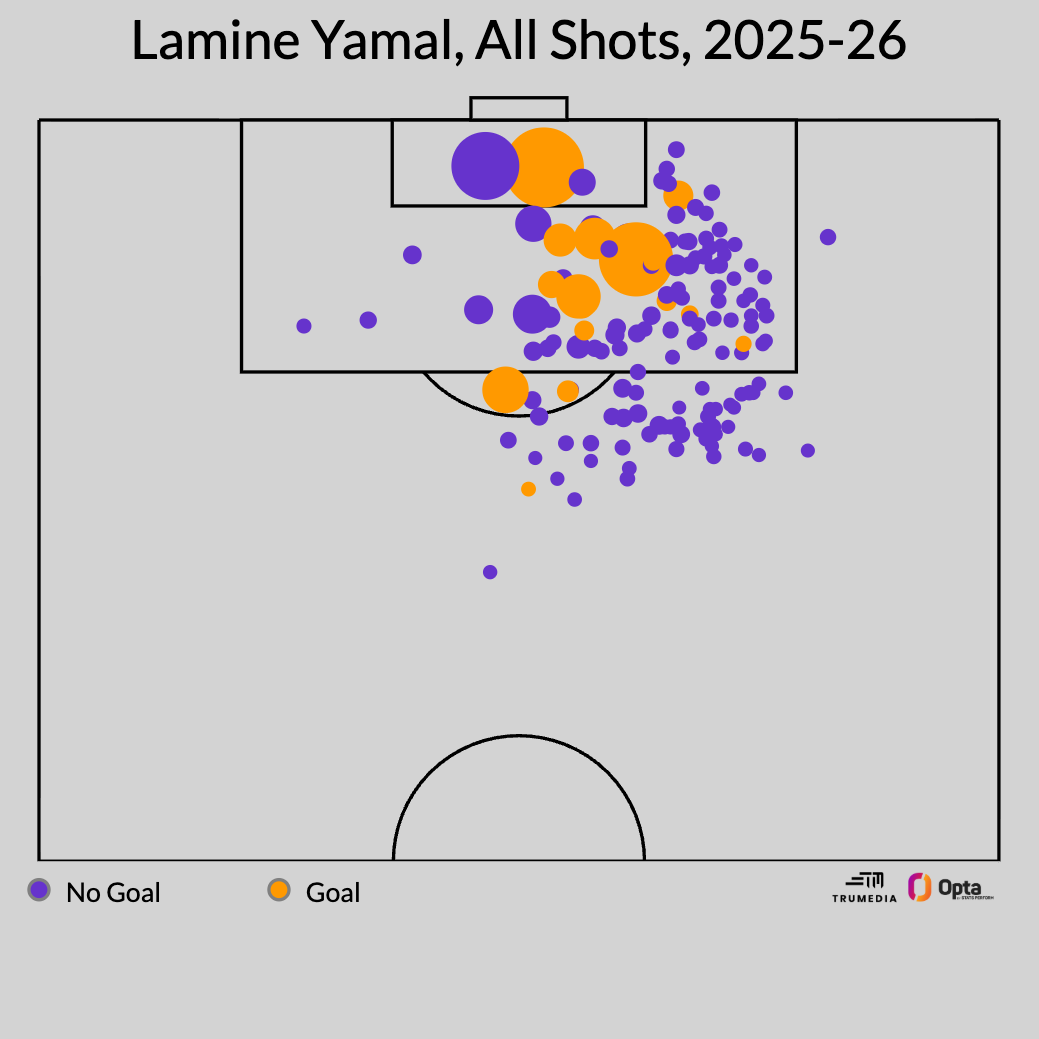
The larger the circle, the higher the expected goals value of the shot. See how few of the shots to the right of the goalmouth were scored?
If Yamal stops taking those lower-xG shots and turns them into either (1) shots from closer to the center or (2) more chances for his teammates? Then there won't be a discussion about who should be first on this list.
1. Ousmane Dembélé, forward, Paris Saint-Germain
I know that Dembélé can't handle the load that anyone else on this list is asked to carry. How do I know? Well, he has literally never done it. He has played 2,000 minutes in a domestic season once in his career, and that was with Borussia Dortmund 10 years ago.
That is all true, as is this: He's the best player on the second-ever team to win back-to-back Champions League titles. The physical frailty is perhaps the price Dembélé has had to pay for being the most complete attacker of the current era.
He's an elite goal scorer, chance creator, dribbler, passer and presser -- and that's all true no matter what foot he's using. He can play in any system, and he can play anywhere across the front three.
Longevity? He's not close. Reliability? Probably not. Durability? No way. But this is a list of the best soccer players in the world right now. And as long as Dembélé is healthy, I don't think there's anyone alive who is better at playing soccer than he currently is.