
It feels like just yesterday that Arsenal were lifting the Premier League trophy, ending their 22-year drought. Since then, we had a memorable World Cup (for both good and bad reasons), along with a ton of transactions from PL clubs as they continue to flex their financial might.
This upcoming season could be chock-full of excitement. For one, only Arsenal within the traditional Big Six have the same coach/manager they had to begin last season, Mikel Arteta. Chelsea (Xabi Alonso), Manchester City (Enzo Maresca), and Liverpool (Andoni Iraola) all have new faces in the dugout, while Manchester United (Michael Carrick) and Tottenham Hotspur (Roberto De Zerbi) are sticking with the guys they hired during the campaign.
Of course, it's not just the new managers who might hold the keys to how their team will fare when the new season kicks off Aug. 21. Let's preview the entire Premier League by picking out the individuals who, for better or worse, could define their team's season.
(NOTE: Teams are listed in order of their finish in 2025-26 from first to 17th, with the three promoted teams at bottom.)
- Premier League kits, 2026-27: Ranking every jersey as they are released
- Karlsen: One U-21 player to watch on all 20 PL teams
- Men's summer transfer grades: Rating every major move
 Arsenal: Ben White
One of the enduring images from Arsenal players collecting their Premier League winners' medal at Selhurst Park was Ben White walking with a heavy knee brace, having sustained a medial collateral ligament injury in May versus West Ham. It had been a rough couple of injury-filled seasons for White, starting in only 22 league matches.
It feels like forever ago, but in 2023-24, White was one of the best fullbacks out there. He was in many ways Arsenal's Swiss Army knife, ably performing in a number of roles. He could tuck inside for long stretches in some matches, while making overlapping runs in others to complement Bukayo Saka and Martin Ødegaard on the right flank as the core of the team's attack. White was able to tailor his game to meet the needs Arsenal had at the moment.
Arsenal are looking to repeat as Premier League champions, something they've not done since the 1930s. With notable injuries to the likes of William Saliba and Jurriën Timber, both of whom won't be fit until well into the new season, there are minutes up for grabs. If White can find a way to be consistently healthy, it would be a massive boost for the North London club.
 Manchester City: Enzo Maresca
You never want to be the guy who has to replace The Guy. Not only does Enzo Maresca have the unenviable task of replacing the best coach in Manchester City's history, but the guy who arguably shaped modern tactics into what they are today. While the move seemed telegraphed for a while in part due to Maresca's time with Pep Guardiola as an assistant in the 2022-23 season, it doesn't make it any easier.
Maresca's résumé to this point perhaps doesn't scream of someone you'd expect to take over at such a high-profile spot. He did help lead Leicester City to win the Championship in 2024 in his lone season there, although they were seen as the preseason favorites. There were times during his Chelsea tenure when he had difficulty balancing out the success of playing end-to-end football with establishing control in matches for the long-term health of the club. However, he was doing it with a very young squad, which should be accounted for.
What will be interesting is how Maresca continues to adapt to the current climate of heavy man-to-man marking out of possession structures, and needing to win one-on-one duels across the pitch. The old style of heavy territorial dominance from elite clubs has waned, and now they're having to find new ways of creating dynamic situations. He'll get to figure this out while having some of the largest resources at his disposal, but time will tell whether or not it works.
 Manchester United: Benjamin Šeško
The last time a Manchester United player scored 20 or more non-penalty goals in a league season was when Robin van Persie did it in 2012-13; coincidentally, it was also the last time Manchester United won the Premier League. Elite goal scoring has been a constant problem ever since Van Persie exited his prime, despite the club spending big on forwards and wingers in the years since then.
When Man United signed Šeško last summer, it was the club's latest attempt to finally find that elusive long-term starting striker. They were gambling that the tools he possesses (straight-line speed, power generated on shots) would win out over time and he could become a dependable goal scorer.
Most would conclude that Year 1 was at least a minor success. A non-penalty expected goal per 90 rate of 0.51 at a shot rate of 3.36 are strong indicators of performance, with both metrics landing in the 90th or higher percentile among forwards within the Big Five leagues. Šeško's physical advantages started to come to the fore as the season progressed, and the added weight put on in the offseason could help him improve even more in the box.
Year 2 will see how he can handle the added workload of Champions League football as what looks to be the undisputed starter.
 Aston Villa: Emiliano Martínez
One of the under-the-radar storylines last season was the wide gap between Aston Villa's output and underlying talent. Their goal differential of plus-7 was a stark contrast to their expected goal differential of minus-5.7. Teams Lab's expected-point model had them 13th, a far cry from their fourth-place showing. Hot finishing was the key driver of this, with them placing fourth in conversion rate and second only to Tottenham for the biggest positive swing between their non-penalty goals and expected goals.
Another factor: Emiliano Martínez had a good shot-stopping season. He ranked seventh in total goals prevented at 3.1 and while his numbers over the years have run hot and cold, he has produced some major moments as a goalkeeper to help bolster his reputation. The ultimate example was him saving Argentina's hopes in the 2022 World Cup final with the famous toe save on Randal Kolo Muani. Aston Villa continuing to outpace the models will require Martínez to maintain his strong run of form.
 Liverpool: Andoni Iraola
It can't be understated how good of a job Iraola did with Bournemouth. All you can ask from a coach at a smaller club is to get the team toward being greater than the sum of its parts. That is how you get a club of that size to unexpectedly finish in sixth place last season and qualify for the Europa League, despite factors which should've pushed them a different direction (placing faith in younger talents, below average wage bill, etc.).
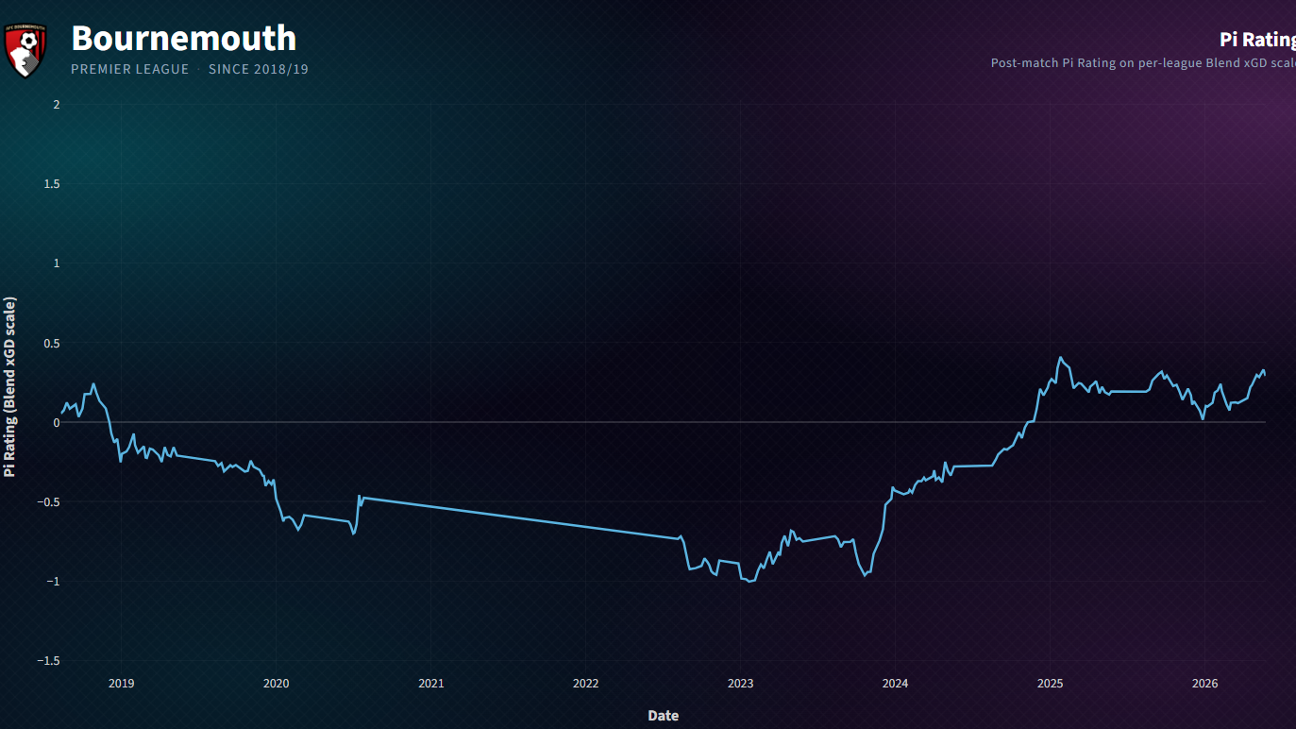
One of the ways we can visualize Bournemouth's success over the past three years is through Teams Lab and their Pi rating, an attempt at measuring team strength in a more holistic manner by including expected goal difference, compared to other metrics like Elo. Zero equates to an average team, and Iraola took over when Bournemouth were comfortably below the mark. By the end of the 2025-26 season, they were firmly above average.
Now comes the hard part, which is trying to be successful at a club like Liverpool. The combination of a hybrid press out of possession, along with constantly trying to destabilize opponents on the ball through aggressive ball carrying, allowed for the Cherries to play at a controlled frenzy and made them must-see television. There have been questions about whether their helter-skelter style of play at previous stops would scale up when having to regularly face deeper blocks. While there were some hints last season of Iraola figuring this part out, we'll get a much better idea now.
The upside case for Iraola is he ends up being this generation's Jurgen Klopp, a heavy out of possession coach who was able to find ways of playing at a slower tempo without sacrificing deadly direct play. Liverpool fans are certainly hoping Iraola follows a similar path en route to becoming one of the best coaches in the world.
 AFC Bournemouth: Marco Rose
Having to replace someone as good as Iraola was always going to be a tough task, but doubly so given that AFC Bournemouth will be juggling European football (via the UEFA Europa League) as well. The Cherries have tried to strengthen their depth of playable guys this summer to deal with the increased fixtures list. Álvaro Rodríguez showed flashes of being a unique yet effective forward in Spain, while center back António Silva was the caliber of prospect who was being linked with big clubs not too long ago.
The guy handling this is Marco Rose, cognizant of Iraola's huge legacy he must follow. Although there are broad similarities with the two of them when it comes to prioritizing high octane football, the ways they achieve it are different. Rose's time in German football includes some domestic success with the likes of Borussia Mönchengladbach, Borussia Dortmund and RB Leipzig. However, he was never able to achieve real success in Europe over multiple years.
He will be given some grace in the early weeks (and maybe even months) of the season, although the mandate is to remain competitive in this new era for Bournemouth. Time will tell whether or not Rose's time in the south coast is an example of a good or bad succession plan.
 Sunderland: Brian Brobbey
For someone who only scored seven times in the Premier League, Brian Brobbey might be one of the more influential players in English football. The main reason? He might be one of the best back-to-goal forwards in Europe at the moment. His ability to carve out space for himself is mightily impressive and when he pins defenders, his marker often concedes territory due to him using his strength.
This is very helpful for a club like Sunderland that otherwise struggles to manufacture final third touches. Via MarkStats, Sunderland had the fourth-lowest field tilt in the league (percentage of ball possession based on touches completed in the final thirds of the field). It was his back-to-goal play that helped set up their famous away win at Stamford Bridge against Chelsea.
A lot of things went right for Sunderland en route to finishing seventh and qualifying for the Europa League. One of them was Brobbey providing a platform for teammates to have an easier time. At 24, he is approaching the peak of his powers. The Black Cats will need him to continue being a handful for opposing central defenders to deal with if they want to have another successful season.
 Brighton: Yankuba Minteh
Brighton had ample momentum at this same time last year. They had finished eighth in 2024-25 under new coach Fabian Hürzeler, once again crossing the 60-point threshold with a ton of young guys who looked prime to take the next step. One of those guys is Minteh, who had a rate of 0.49 non-penalty goals and assists per 90 in his age 20 season. He had electrifying moments, including his PL debut against Everton.
Minteh's second season in the PL was disappointing, seeing his goals and assists output on a per 90 basis nearly halved. While he was still getting into the box on a regular basis (although less than in 2024-25), the final ball wasn't there and his decision-making showed some room for improvement too. An explosive player like him should be much higher than the 48th percentile for shot-ending carriers within the Big Five leagues, according to Sahil Gidwani's Footverse app.
Prospect development can be a tricky thing. We expect them to go from strength to strength with each passing season, but the reality is a lot of young talents have uneven development paths. Perhaps Minteh's third season in English football will be the one where he irons out his game and gets closer to star status. Brighton's upward mobility in the table depends on him and other youngsters on the roster taking the leap.
 Brentford: Mamadou Sangare
Brentford have done a remarkable job over the years of punching above their weight in the Premier League. Last season might've been the best example of them accomplishing the feat. Not only did they lose previous manager Thomas Frank to Tottenham, but key contributors Bryan Mbeumo, Yoane Wissa and Christian Nørgaard also left. No worries, Brentford went on to finish ninth and narrowly finished out on qualifying for Europe.
Part of Brentford's strategy has been not going big on transfer fees. Since coming up to the PL in 2021, they've only spent £30 million or more on a single player three times. The first was Igor Thiago in 2024, who rebounded from a major knee injury two years ago to finish second in goals behind Erling Haaland. Dango Ouattara was the second from last year, and while he doesn't have the gaudy goal and assist totals, he provides substantial value through his up-tempo style of play.
We've not seen Brentford spend big on a midfielder, which makes the signing of Sangaré for a club record fee all the more fascinating. He was one of Lens' best players last season as they finished second in Ligue 1, and even for a bit looked like they could push Paris Saint-Germain for the title. A midfielder who can ably progress the ball, cover significant ground out of possession, and make plays are incredibly valuable. That was the upside Sangaré flashed in French football.
If Sangaré plays at a similar level to what he did in France, he will immediately become one of the PL's better players and make other clubs regret not signing him first. For Brentford, he could help them push for Europe once again.
 Chelsea: Morgan Rogers
There are multiple candidates to choose when it comes to who might define Chelsea's upcoming campaign. Xabi Alonso is trying to prove that his tough time coaching in Madrid was mostly the byproduct of bad circumstances, and Cole Palmer has not yet returned to the attacking force he was from 2024. However, it's hard to look past Rogers, given Chelsea spent a whopping £117 million to acquire him from Aston Villa this summer.
You can see why a lot of people rate Rogers highly. He can find space between the lines, and from there can make quick actions with either foot to help progress play. This includes combining with teammates in tight areas. While he has those skills and others to fall back on, the progressive carries are arguably his defining feature.
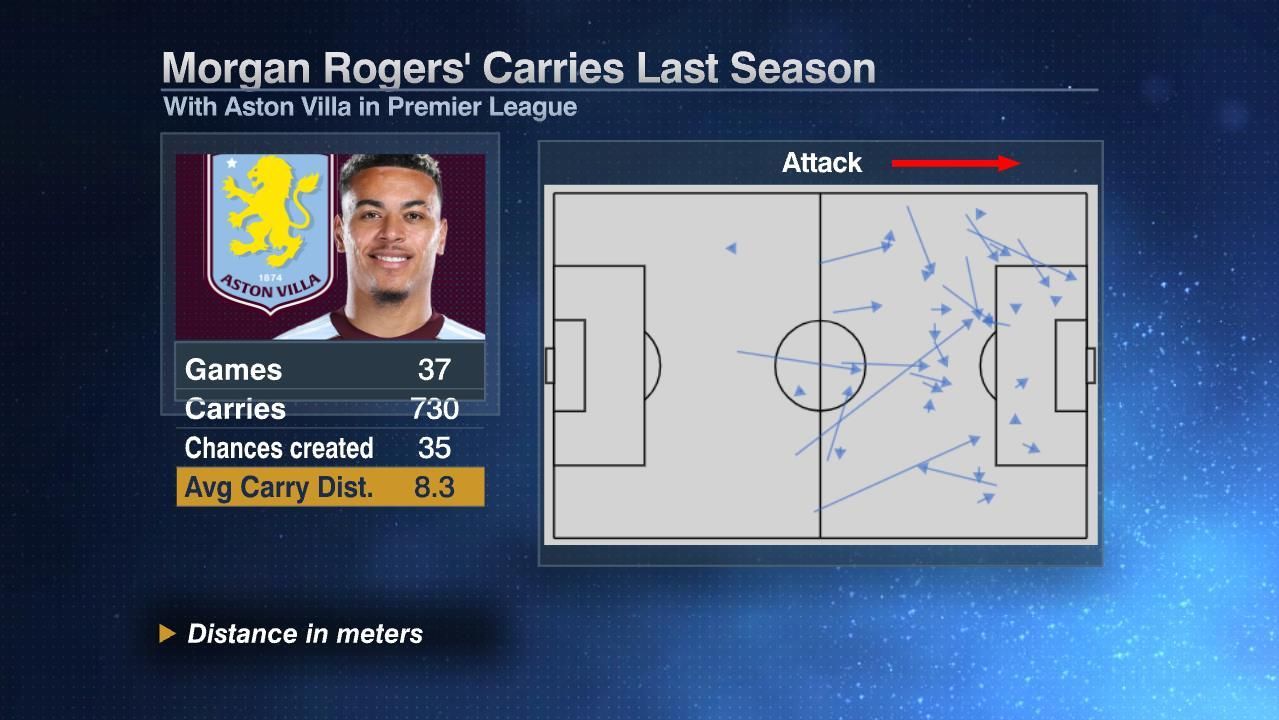
According to Pranav's Playerprint app, Rogers is in the 70th percentile for progressive carries and 85th percentile for carries into the box among attacking midfielders in the Big Five leagues.
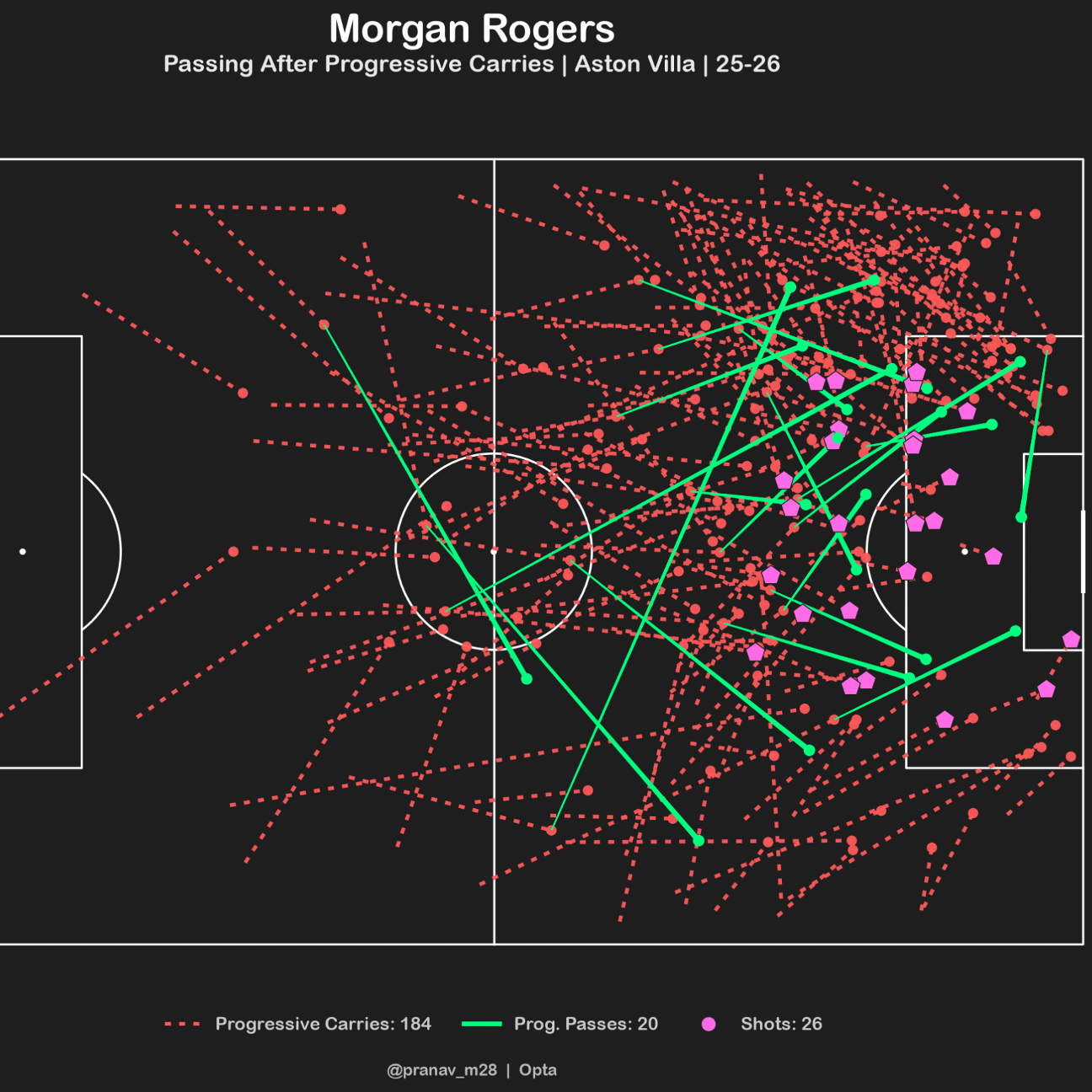
The question is whether Rogers can put it all together to truly provide superstar impact. Some of the value he provided last season came from hot shooting (10 goals on 6.78 non-penalty expected goals), although he has in the past outpaced his underlying production. Even with how expensive interleague spending is, Rogers would have to regularly produce 20-plus goals and assists to be anywhere near worth the price Chelsea paid to sign him.
 Fulham: Kevin
Eyebrows were raised near the end of the 2025 summer window when news dropped of Kevin signing for a club-record fee. Splurging on an attacking talent made sense given how much one can impact a team's attack and overall record. For a club like Fulham that's trying to push on toward the top half, unearthing a star is how they can close the gap.
Year 1 for Kevin was a mixed bag. There were some electrifying moments as a progressive carrier and if you squinted hard enough, you could talk yourself into him eventually turning into a high-impact winger. However, the output was not there. Only a goal and assist in more than 1,000 minutes, with underlying production around the same level. One bright spot is he was above average among his cohort for carries ending in a shot (63rd percentile) or chance created (67th percentile). Becoming more of a final-third threat would vault him up multiple levels and make Fulham a bigger threat.
 Newcastle United: Ross Wilson
This summer has seen Newcastle signal that they're going into a new cycle as a club. On the pitch, Sandro Tonali, Bruno Guimarães, and Anthony Gordon have departed in big money transfers, and all this a year after losing their talisman Alexander Isak to Liverpool in English football's biggest-ever transfer. Off the pitch, there has been a major change as well. Eddie Howe had been there since November 2021 and became an influential figure, particularly after helping deliver Newcastle's first trophy in 56 years with the 2025 League Cup. However, losing three mainstays in one window helped lead to him resigning from his post, with Matthias Jaissle taking the reins.
All of this adds pressure to Wilson, who took over as Newcastle's sporting director last fall. This is the first summer where his work can be fairly critiqued. This is especially true with regards to transfer recruitment, which in recent times has not been a strength of the club. Last summer saw them bet big on Wissa, Nick Woltemade, and Anthony Elanga but saw minimal return in Year 1. Newcastle have also had multiple big targets spurn them for another destination, including this summer with Johan Manzambi.
So far, Wilson is betting on upside with recruitment. Here are the ages of the five signings on permanent transfers:
- central midfielder Sean Steur: 18 years old
- goalkeeper Ewen Jaouen: 20
- central midfielder Aladji Bamba: 20
- winger Bazoumana Touré: 20
- goalkeeper Lukás Hornícek: 24
Perhaps it works out and Newcastle can return to prominence soon, but what's happened this summer seems like an acceptance that a rebuild will commence in Tyneside.
 Everton: Hayden Hackney
You could make the argument that Hackney had done enough to earn a PL move around two years ago. For four seasons with Middlesbrough, he was a one-man progressive passingand carrying machine. Among midfielders in the Championship last season with 600 minutes or more played, this is where he ranked in the following metrics via the Footverse app:
- 78th in percentage of passes played into the final third
- 93rd in expected assists per 90
- 100th in progressive carries per 90
Hackney is the definition of a technically gifted midfielder. Time and time again in the Championship, he would bypass incoming pressure to get the ball forward. Sometimes it was a simple short pass between two opponents, other times he'd carry a few yards to set up an attempted pass in behind for teammates to run onto.
Unsurprisingly, Hackney was named the league's player of the season and had firmly reached the point of needing to challenge himself in a more talented environment. Everton are banking that he can become their version of what Adam Wharton has been with Crystal Palace. How long it'll take for David Moyes to give him the keys in midfield is anyone's guess, but if it's soon, it could be a boon for the club.
 Leeds United: James Trafford
Before the beginning of the 2025-26 season, the general consensus was Leeds United faced an uphill battle if they were to stave off relegation. This was at least partly influenced by having all three promoted clubs suffer the drop after only one season in both 2023-24 and 2024-25. That ended up not being the case, as both Leeds and Sunderland ended up comfortably surviving the drop (the latter even qualifying for the Europa League). Leeds, meanwhile, eventually leaned into a tactical game model based on winning second balls, athleticism, and overall direct play, suiting the roster at hand.
What made Leeds' 14th-place finish even more noteworthy was it didn't come off the back of a conversion heater. In fact, they were bottom five for both conversion rate for and against. The goalkeeper position had been a sore spot for a while, but the expectation James Trafford is the solution. A club-record fee and the highest figure spent for a British goalkeeper indicates they think he's the guy.
The last time he was a regular starter came two years ago when he helped backstop Burnley to second place and automatic promotion from the Championship. The shot-stopping numbers in particular were ridiculous, saving 12.48 goals above expected according to Opta. If he can come anywhere close to replicating that form, there might be a path for Leeds to improve further this season.
 Crystal Palace: Jaydee Canvot
Since summer 2024 when Michael Olise left for Bayern Munich, Crystal Palace have had to deal with at least one high-profile departure during every offseason transfer window. This is the reality for clubs at Crystal Palace's level, constantly having to come up with a succession plan to ensure they don't descend into chaos (just ask Leicester City). Last summer was Eberechi Eze's departure to Arsenal, and now with Maxence Lacroix to Chelsea (not to mention Marc Guéhi's exit in January to Manchester City).
While Crystal Palace haven't yet been able to truly replace what Olise and Eze brought to the table, they're hoping Canvot can step up and be their new stalwart on the backline. His skill set is the kind everyone is looking out for. He has shown moments of marrying front foot style of defending with promising progressive passing. There's also a chance he becomes one of the better ball carriers among his position.
There have been some growing pains for Canvot so far in English football, but he started to come into his own by the time Crystal Palace won the Conference League in Leipzig. Many are excited to see what's next.
 Nottingham Forest: Neco Williams
Nottingham Forest took a gamble in the summer of 2022 when they spent in the region of £16M for Williams. At that point, he was firmly behind established stars in Andrew Robertson and Trent Alexander-Arnold at fullback, which meant game time was minimal. A loan spell with Fulham in the second division in 2021-22 amounted to only 14 starts.
The move to Forest has certainly worked out for both the player and club in the years since, with his directness and all-action style of play helped fuel their counterattacks. His improvement in using his left foot has made him a unique weapon on the left side, capable of going wide toward the byline or cutting inward with the right foot. He ranked last season in the 82nd percentile among Big Five fullbacks for both expected assists per 90 and chances created, alongside 83rd in completed open-play crosses.
Given how Oliver Glasner deployed Tyrick Mitchell and Daniel Muñoz as wingbacks with Crystal Palace, he'll probably be excited to have someone of Williams' caliber who combines wide creation of a high caliber with formidable one-on-one defending against a variety of opposing wingers.
 Tottenham: James Maddison
There's no getting around the fact that Tottenham have been far below par over the past two years. While winning the Europa League was the saving grace in 2024-25, 2025-26 had no such silver lining. The lack of any credible passers and heavy emphasis on athleticism via physical metrics led to a Frankenstein-esque squad which nearly got relegated.
Part of why Tottenham couldn't consistently get the ball forward was the guy best suited to knit it all together was out for the entire season. When Maddison tore his knee in preseason last year, it took away one of the few guys who could actually get on the ball and make stuff happen.
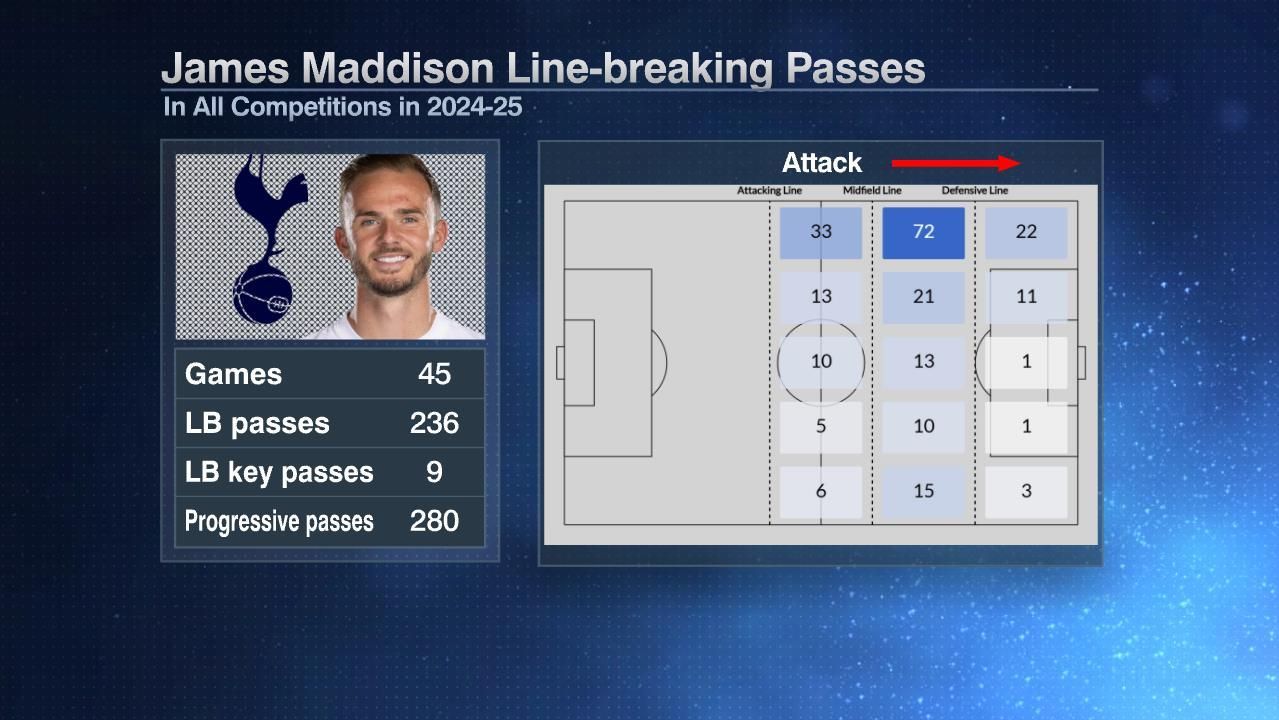
Courtesy of the Playerprint app, he was in the 91st percentile among midfielders for progressive passes per 90, 92nd in through balls, and 92nd in key passes. He has long been one of the more dynamic playmakers in England.
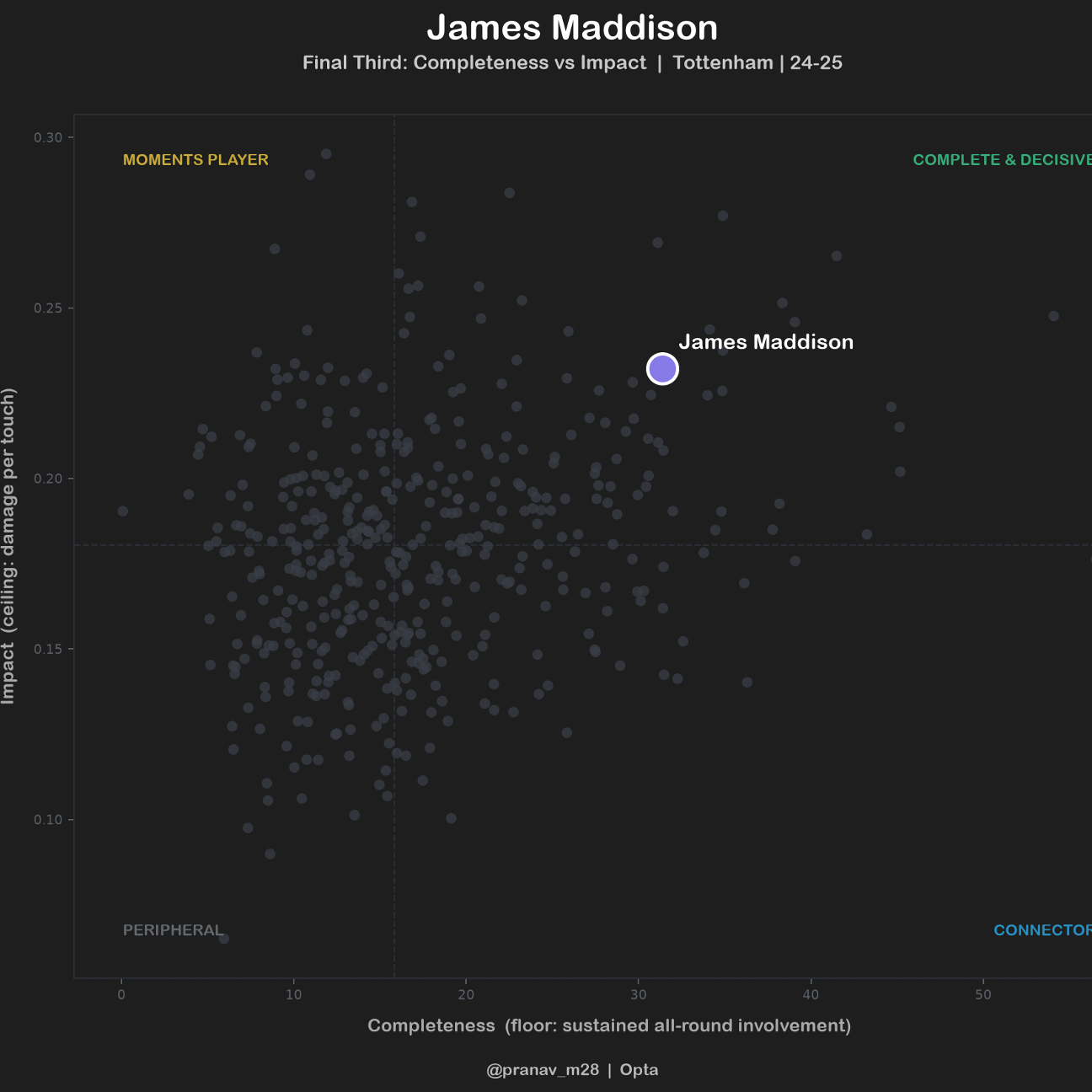
Tottenham will not have quite the same passing concerns this time around. Jan Paul van Hecke, Marcos Senesi, and Mateus Fernandes are all capable of finding teammates in pockets of space. Any hopes of Spurs returning to being a threat for European qualification will likely require Maddison to provide meaningful minutes at a level approaching where he was before the ACL tear.
 Coventry City: John Dempster
If I was to explain why Coventry City were able to get promoted from the Championship in 2025-26, one of the biggest factors was their strength from set pieces. According to Opta Analyst, no team in the league took more shots from dead-ball situations or had a higher xG, and only Southampton were able to equal Coventry's 29 goals scored. They were also sixth in the percentage of total expected goals to originate from set pieces.
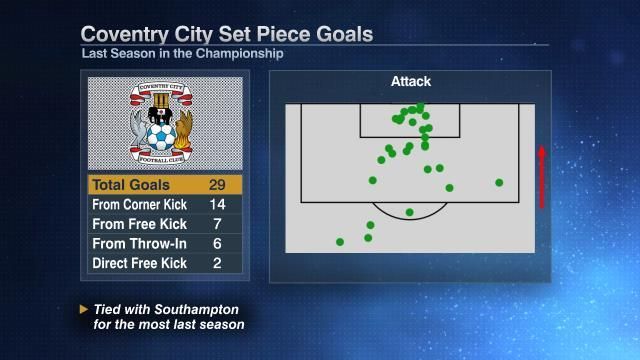
Coventry were able to accomplish this through simple yet effective play designs, including back-post routines in which the opposing goalkeeper was pressured. It got to the point where almost every set piece opportunity carried the real threat that a big chance would be generated. It can't be understated how good Coventry were in this area.
In the past, smaller clubs could rely on set pieces to give them more of a fighting chance against opponents who had the talent advantage. Brentford are the go-to example for this as they've regularly been among the best at producing goals from these routines. The problem is we're in the era of the Premier League where set pieces have never been more commodified by the clubs at the top. Look no further than the current league winners in Arsenal.
This is the dilemma that set piece coach John Dempster and the rest of the staff face. The safe bet is Coventry won't replicate their success in the top flight; just how much of a decline in production occurs will help determine how the club fares.
 Ipswich Town: Emersonn
Ipswich Town are once again in the Premier League, having gained automatic promotion from the Championship with a second-place finish. The first time around in 2023-24 was essentially house money since they remarkably shot up from League One to the PL in back-to-back seasons. This time around, the hope is they'll at least be a bit more competitive while trying to avoid relegation.
There has been a global approach to their recruitment this time around, no longer fixated with signing players from English sides. While it's by no means a certainty that the shift will work, it at least guarantees they won't have to deal with paying a premium on domestic talents.
Part of the uncertainty comes from their headline signing in former Toulouse forward Emersonn, who has only one year of experience as a regular starter in a major league. The per-90 rate stats are encouraging, ranking in the 82nd percentile among forwards for shots and 86th in non-penalty expected goals. There's the outline of the kind of physically combative forward who can hang in the English game.
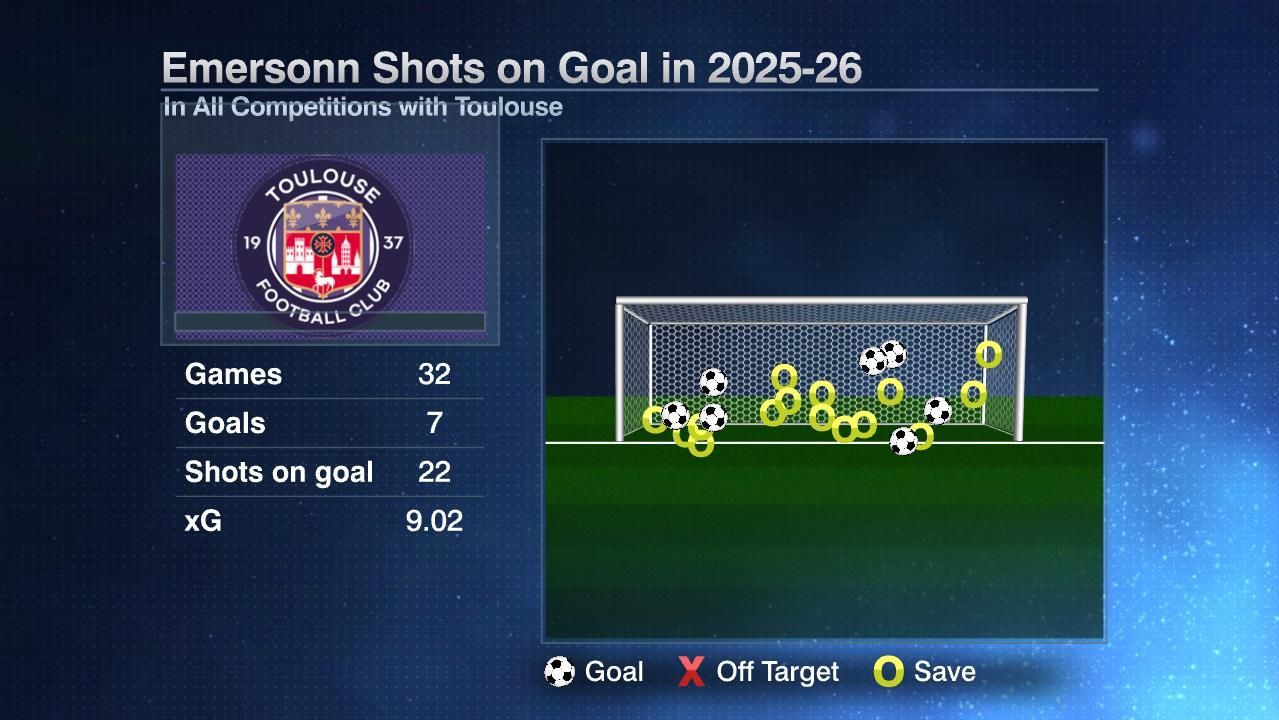
Any chance of Ipswich Town holding their head above water in the Premier League hinges on getting credible striker play. The belief is Emersonn ends up being one of those guys who takes to the league in a seamless manner.
 Hull City: Variance
We're admittedly cheating here by not having an actual person to represent Hull in this exercise, but I think the story of Hull's return to the Premier League involves being on the receiving end of good fortune. They led the league in conversion rate for, and had the fifth-lowest conversion rate against. This helped make up for them being outshot by 175, and an expected goal difference of minus-19.5. Teams with this statistical profile never qualify for promotion, yet they were able to do so.
Unsurprisingly, Hull are seen as the heavy favorites to go down, with some even wondering if they can outdo 2008 Derby County's record-low total of 11 points. To this point, they've not spent heavily in the transfer market. Should that remain the case by the deadline, it's hard to see how Hull can be competitive in 2026-27.