

Arsenal have signed Newcastle United midfielder Bruno Guimarães, who is considered one of the best in his position in the Premier League. But where will the Gunner's new £75 million signing fit into an already stacked title-winning squad?
Guimarães was an established first-team regular in Brazil by his early 20s at Athletico Paranaense, but he moved to Lyon in January 2020 for a reported €20 million. Then just 22, he initially needed time to adjust to life in French Ligue 1. But, during his first full season, it became evident that he would attract interest from even bigger leagues.
Eventually, it was Newcastle that landed him in January 2022, paying €40 million plus add-ons exactly two years after his arrival in Europe.
At St James' Park, Guimarães established himself as one of the Premier League's most consistent central midfielders. He arrived primarily as an industrious, defensively minded midfielder, yet gradually became a more complete all-round presence. That development was clear last season as he scored nine Premier League goals, comfortably the best return of his career.
Now he embarks on a whole new challenge in London, with the reigning champions of England.
Position
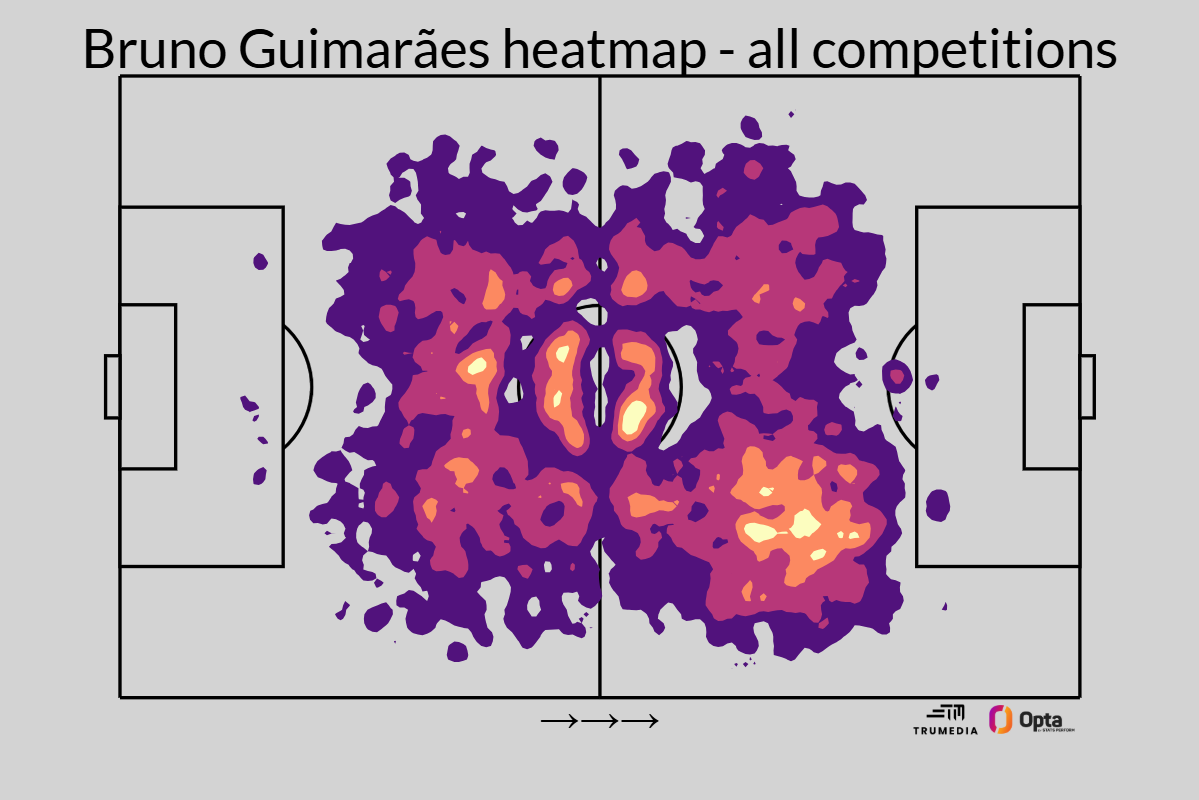
Though capable of operating as a deep-lying No. 6 midfielder, the past year or so suggests Guimarães is arguably better suited to a box-to-box No. 8 role in which he can take part in the buildup without being permanently restricted to protecting the space in front of the center backs.
Off the ball, he's more proactive than a traditional holding defensive midfielder as he closes down opponents, competes for second balls, and pushes up higher to participate in the second line of pressure. While he was typically the main point of reference in possession for Newcastle -- often dropping deep to receive the ball under pressure -- his first instinct was to progress play through vertical passes, carries or combinations in the inside channels. From a higher starting position, he also offers more through late runs into the penalty area, which in turn explains his incremental goal threat.
Moving Sandro Tonali into the No. 6 role allowed Guimarães to move to the right of Newcastle's midfield three, with greater freedom to roam, press aggressively and contribute closer to goal. That said, he would still return to the holding role when required, and this flexibility was certainly an added attraction for Arsenal boss Mikel Arteta.
As seen at the World Cup, Brazil used him in a similar manner, but positioned slightly higher up the pitch, either alongside a more defensive partner or as one of the advanced midfielders in a 4-3-3.
Strengths
Guimarães predominately stands out via the range and frequency of his actions. Among Premier League central midfielders, only Manchester City's Elliot Anderson (who starred at Nottingham Forest before moving this summer for £116 million) matches him for that unique mix of quality and industry. While Guimarães can organize possession from deep, carry the ball through pressure and press aggressively, his influence also extends to the final third.
His ability to receive the ball under pressure is central to his game and he actively looks for it in busy areas, then relies on a secure first touch and awareness to escape his opponents. Moreover, he uses his body and athleticism particularly well as he draws contact before getting away from a challenge.
Guimarães' general distribution also ranks highly among Premier League midfielders: his first instinct is to beat pressure or break lines as you can see with his short/medium passing, which is executed with pace, accuracy and nicely tuned angles. As for switches and long passes, he found a teammate on 62% of his 2.2 long passes last season, a standout stat in the Premier League.
Though not an explosive runner, his close control, natural strength and quick changes of direction allow him to move beyond the first opponent. Once released into a higher midfield role, those carries pose a serious threat in the final third (0.4 key passes per 90 minutes), and this positional freedom has also improved his goal threat. His nine Premier League goals last season represented a career-best return and -- surprisingly -- made him Newcastle's leading scorer in the league. (Among those were penalties, headers, a direct corner and a curled finish from outside the box, with timing and anticipation being the common theme.)
His work rate and physicality are also important aspects to his game. Guimarães rarely puts in a sub-standard performance and is hardly ever injured. Key to that continuity is some excellent stamina ,which allows him to maintain intensity throughout the game, while his ability to draw fouls -- he was the second-most fouled player in the Premier League last season (behind Anderson) with 2.3 fouls per 90 -- often gave Newcastle another way out of pressure.
How he can improve
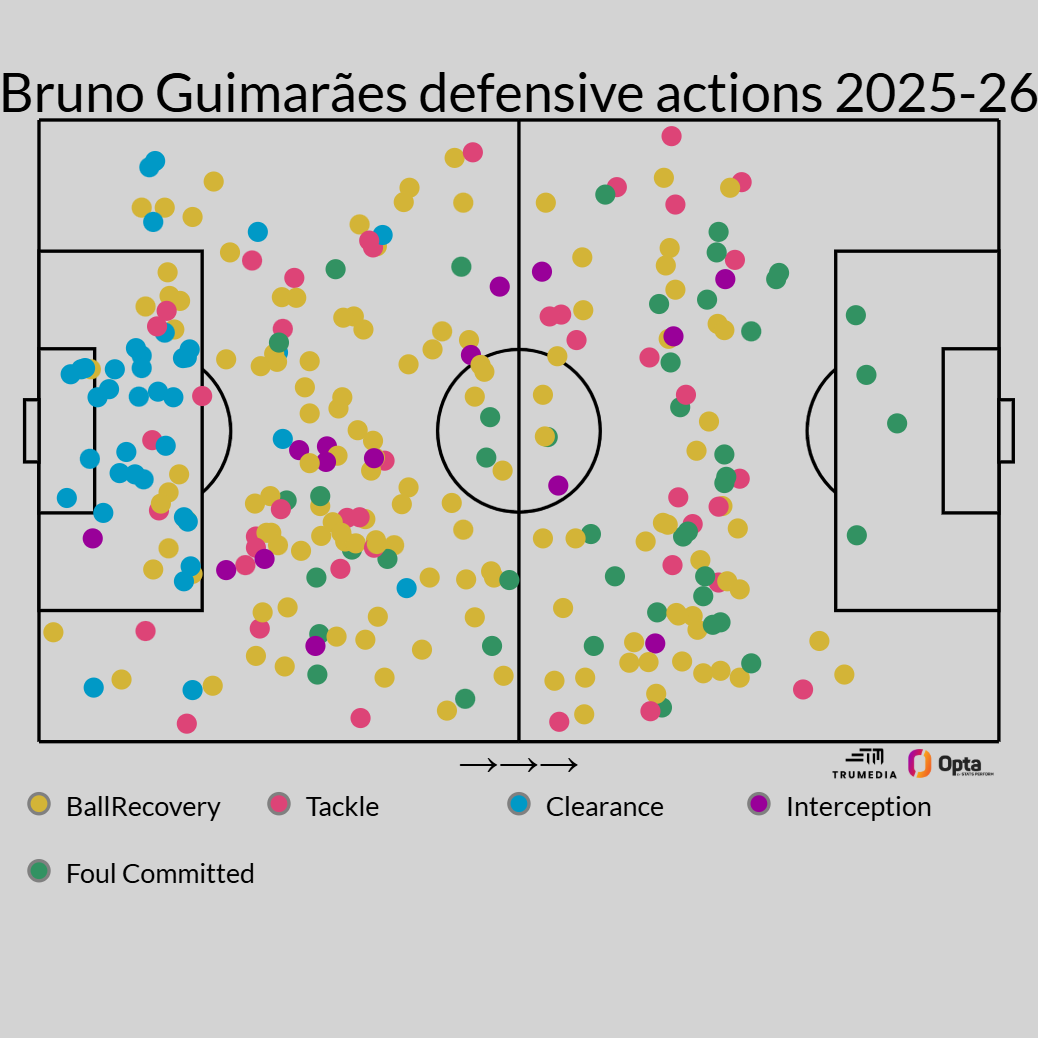
At 28, the Brazil international is largely the finished article -- hence why Arteta has signed him amid his "win-now" recruitment strategy -- and already a world-class midfielder, so any further gains are likely to be marginal. It's mainly a case of integrating him successfully into Arsenal's tactics, though a few unnecessary bookings could be weeded out as his temper can get the better of him when the emotions run high and he engages in disputes with officials.
Otherwise, a bit more restraint when pressing could reduce the spaces that open up behind him, while a little more care with his ambitious passes would limit avoidable transitions without compromising the progressive side of that his game.
Which other clubs were linked?
Juventus were long-standing admirers, while Paris Saint-Germain and Manchester United were also consistently mentioned.
How will he fit at Arsenal?
Guimarães strengthens what was already one of Europe's best-functioning and balanced midfield units. He will replace Christian Nørgaard, who was allowed to leave for Everton.
While Martín Zubimendi generally operates as a positional No. 6 anchor -- tidy, disciplined, rarely leaving his zone -- Guimarães is a more aggressive, combative presence, happy to carry the ball forward, breaking lines with his passing and who thrives in duels.
His press resistance and tempo control also give Arteta a different, more spontaneous rhythm-setter in his 4-2-3-1 formation.
However, with some added tactical freedom, Arteta could use him to push up into advanced areas, adding unpredictability alongside Declan Rice with Zubimendi in behind. Martin Ødegaard's role (as well as the minutes for young Myles Lewis-Skelly and Ethan Nwaneri) might be compromised by this move, but the title holders are to be commended for adding depth, quality and variation to their squad from a position of strength.