

Curaçao are a team of record breakers. They're the smallest nation to ever qualify for the World Cup, on both population and area. They have the tournament's oldest-ever head coach, and they began with the longest odds of winning it.
Just over half of Curaçao's 158,000 population could fit into the Houston Stadium where they played their opener against Germany. The small Dutch Caribbean island is formally part of the Netherlands, with 25 of their 26-man squad born there.
When Curaçao traveled to the United States for the World Cup, few gave them a chance of getting a goal, let alone a result. Drawn in Group E alongside Germany, the Ivory Coast and Ecuador, it was a brutal ask. But under the guidance of 78-year-old head coach Dick Advocaat, Curaçao had a plan to upset the world order.
Over the past week, across Curaçao's opening two group matches against Germany and Ecuador, their forward Gervane Kastaneer has taken ESPN inside their camp.
This is his World Cup story so far, in his own words.
Part I: World Cup debut vs. Germany
The Curaçao team traveled to their training base in Florida off the back of a 4-1 defeat to Scotland in Hampden Park, and then a 4-0 win over Aruba in their farewell game. Kastaneer and his teammates were given a hero's send-off. Their famous blue bus brought the players to and from the stadium, and then to the airport. It's an old, repurposed school bus. Footage of the players dancing on board, heads bouncing against the leaves on the ceiling went viral before their opener with Germany in Houston on June 14.
"We love that bus. I know the video went viral, but that bus is so important to us. There aren't windows, so people on the Island can give you high-fives, you can speak to them too. They scream 'good luck' or 'we love you' and having that connection is so important. The music on the bus is also great. Even our bus driver, Marlon, is well-known back home. It's like he's a celebrity too! It's an attachment we can't get rid of.
"Of course we don't have that bus here, but the one we have is beautiful, a big Curaçao flag on the outside. We've still kept the music, though. When the coach wants to speak, he makes the sign to Leandro Bacuna to lower the volume. And then when he finishes, the volume is right back up again.
"The whole day leading up to the Germany game was magical. I was staying in the same room as [winger] Kenji Gorré and when we opened the window that morning, we saw it was raining, and that's a sign God is happy. He's crying tears of joy. We looked at each other, and just said 'Woah, this is crazy.' When we took our new bus to the stadium, it was like a dream: so many fans waiting for us then. We knew it was big.
"Then as we walked out on to the pitch, we saw our family. There are some guys in our team who I've never seen cry. Even when we qualified for the World Cup, they didn't cry. But then [defender] Roshon van Eijma told me how he saw his parents in the stands, and the moment his mother hugged him, he couldn't hold the tears back. It was the same when I saw my family there -- my mother, Ivionella, my dad, Gerrit, and my sister, Zjaiviënne. My girlfriend, Darleen, and son, Saint Lopes, were also there. My brother, Jernel, couldn't make it.
"My parents are the generation that moved to the Netherlands, to Rotterdam, as they wanted to do better for themselves. My older brother Jernel was born in Curaçao, but I was born in Rotterdam. Growing up the language, and food was all from Curaçao. Sometimes it felt like I was born in the wrong country. We spoke a weird language, half Dutch and half Curaçao [Papiamentu is the native Creole language].
"A lot of people at school couldn't understand me. I think I can speak for a lot of the guys on my team who felt similar: there was something missing, you were different to the other guys and maybe you were also the only black guy in the classroom.
"Growing up I played for the Netherlands youth teams, but year on year, Curaçao was getting serious about football. Leandro Bacuna was the star, while defender Cuco Martina was in the Premier League with Southampton and Everton. They kept on calling me, trying to get me to join and my father said it was my call. I knew I wanted to represent Curaçao -- it's who I am.
"So that's why as I walked out against Germany, I was already crying long before the anthems. When I heard the first notes of our anthem, it was overwhelming: we'd made it. I saw that big flag get rolled out for us, and it was a moment where Curaçao was known in the world.
"I caught the eye of some of the Germany players. They smiled at us, I think they knew how much it meant.
"Dick's last words to us before we started was to remember how we'd trained and make the best of it. Look, we're a small country but we're professional footballers. We were serious. We knew that if we played to our best, we had a chance. But the game was very difficult."
Germany took an early lead through midfielder Felix Nmecha, and it looked ominous for Curaçao. But then, in the 21st minute, Curaçao right back Livano Comenencia hammered home an equalizer. It was the country's first ever World Cup goal.
"It might sound crazy, but I think we can score against any team we play. I'll never forget when we scored. It was a feeling of pure joy. At the time, we deserved it. It wasn't one of those late goals where you're already 5-0 down, it made it 1-1. We felt we belonged."
Germany found another gear, however. They were 3-1 up at halftime and by the time Advocaat turned to Kastaneer, it was 6-1.
"He said to me, just work hard. I wasn't thinking too much, just had to do my job. I was free in my head and focused on the game; I wasn't thinking too much of what was happening around me, I was just playing football. It was only much later in the changing room that I got the goosebumps, knowing I'd played in a World Cup.
"But there wasn't time to really think about that. We were disappointed. The result 7-1 was harsh, we thought it was perhaps two goals too much. It didn't take away from the greatness of the whole day, but the footballer in you wanted to win, and if not, you don't want to let in seven.
"We all watched the game back on our own. We didn't have a party bus that evening. There was no music."
Part II: Between games
The Curaçao team, including Kastaneer, flew back to Florida that evening and their base at Boca Raton. Next up for the Blue Wave was Ecuador on June 20 in Kansas.
Daily routine:
8:30 a.m. -- Breakfast
10:00 a.m. -- Training
12:30 p.m. -- Team meeting
1:00 p.m. -- Lunch
7:30 p.m. -- Dinner
11:30 p.m. -- Back to room
"I've never had issues sleeping before or after a match. Some of the guys really struggle with the adrenaline and anxiety 24 hours out, but it's never affected me. The morning after the Germany game, some of us trained, and the guys who played the full 90 minutes had a light session.
"Dick had told us afterwards that he felt 4-1 would have been a good result, but seven was too many. But we were disappointed still at how many we let in. During the week in between matches, we have our daily structures but some of it is left up to us.
"Bacuna and I do the fines. If a player is late or something, he gets fined. The guys are doing very well now, but in the beginning, it was a little bit difficult for them. They had a lot of fines. Now everyone is on time and doing good. Bacuna is also in charge of the music, along with [forward] Jearl Margaritha. We are serious on the pitch, but try to have fun off it.
"But Dick was angry with how we played in certain moments against Germany. He pointed out how we needed to be tighter in defence against Ecuador, and how we have to stay focused on our system.
"We knew Ecuador was going to have a lot of pressure on the ball, and when Dick talks to us about this, he is very serious. There was no time for joking in training, and you know it. When me or [striker] Jürgen Locadia missed a chance in a four vs. four match in training, he'd raise his voice immediately at us. He tries to keep us sharp.
"Dick talks to us in Dutch -- I'd say overall we talk 60% in Dutch, and 40% in our own language. Keeping in touch with our Curaçao roots is so important.
"We're also very religious. Back at our training camp in Holland, we were visited by a minister from the local church to pray with us. When we look at the world, we see a lot of opportunity there for us. As a people, we have a lot of courage to try a lot of things. We aren't scared to fail, and we try to do the best in life. We have a positive mindset and we're hardworking people."
Before the tournament, Kastaneer was handed a letter from his father. FIFA filmed the reaction as his dad, Gerrit, told him how proud he was of the journey he had been on, and how he had fought back from almost being forced to retire due to a freak eye injury in January 2017.
"We played a friendly against FC Mainz 05, and they were keen on me. I played well against them, and they agreed a fee with my then club ADO den Haag and offered me a five-year contract. It was life changing money, and I was heading to the German Bundesliga. Before I could join them, ADO still had two matches. We agreed I'd sit them out. But they lost the first one against Heerenveen, and they made me play the second one against PEC Zwolle. I spoke to my father about it, and though we were uneasy as I was being pressured into playing, we agreed I'd play to end things nicely with the club.
"It started well; I scored from a corner kick. Five minutes later, in the 21st minute, I wanted to play a long ball to the other side. I cut it back, and the ball got a little bit away from me. I still tried to play the long ball. The opponent was in front of me, with his back turned to me and his body was leaning forwards. So as I kicked the ball, it bounced off the sole of his boot and spun back up and hit me straight in my right eye.
"My eye went black. There was only a tiny light coming in. We were playing on artificial grass, so I told the doctor, "can you take the rubber crumb out of my eye please"? I thought my eye was full of the little black dots that make up the pitch. He said "There's nothing in your eye." I was told to wait five minutes and it would be fine again, but it didn't improve.
"So I went to hospital. There was a lot of blood in my eye and my retina was completely loose, just hanging by a thread. Mainz phoned me and took me to Germany for treatment. The person was called Esther Hoffman. They said I had 0% visibility in the eye. They said they could maybe get it to 50%, but that's really hard, so 25% is more likely. That's the minimum visibility you're allowed to play professional football.
"I needed two operations. The first took the blood out, the second was to try and place the retina back and they put gas into my eye, too.
"It took six months to recover. I had to play with glasses, to protect my eye as the bone was still recovering. Of course. Mainz had a big decision to make. I'd signed my pre-contract. We had a meeting with the manager, Rouven Schroder, who's now at Monchengladbach. It was me, my dad and Mainz.
"Mainz had been incredible. They paid for everything, and my father still loves the club to this day. They sat there and told us, plainly, that they didn't know what to do. At that point it wasn't clear if my eye would recover. Eventually, it took my dad to make the call.
"He turned to them and said: 'Look, I understand. You wouldn't buy a car if it had three wheels would you?' I was so mad, I remember thinking 'What is this guy doing?' Dad continued: 'When he's good, he'll come back to you.' They started crying, and I just didn't know what my father was doing. He'd taken everything away from me. But now I understand. He was making the best decision for me.
"The Mainz move didn't happen. but I signed for Kaiserslautern [in Germany's second division] instead.
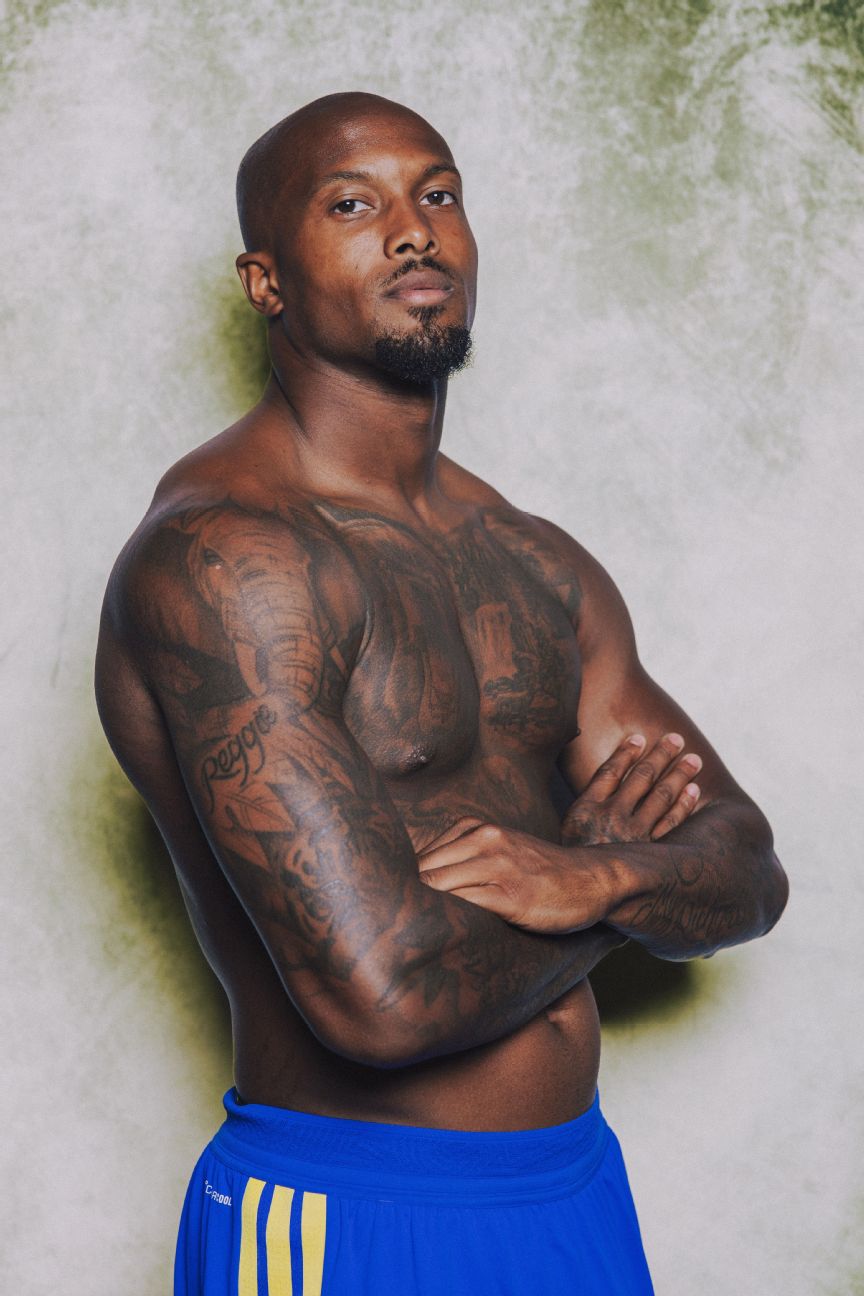
"My tattoos sum up my journey. I am covered in animals. I have an elephant as when they under attack, the big elephants go in a big circle and the younger ones go in the middle, so that's how they protect their family. It stands for family. There are hunters out there and you want to do all you can to protect your family."
Part III: Facing Ecuador
Curaçao traveled to Kansas, Missouri the day before their second World Game game against Ecuador on June 19. The following morning, hours ahead of the game, team captain Leandro Bacuna addressed his team.
"Leandro showed us a video of the youth teams of the Blue Wave. From the under-9s to the U20's, all telling us how proud they are of us: win or lose, they want to follow in our footsteps. When I started eight years ago, we fought so hard to put soccer on the map. It's a country which was always baseball, but now a lot of the kids in Curaçao want to play football, so that's made us so happy.
"We are very calm as a group. I think we can surprise some people. We're a couple of hours out now from travelling to the stadium, and my nerves are okay. It's when I get into the stadium, then all the nerves come. My belly goes crazy. But we are confident we can get something off Ecuador. Any result would make our trip."
Curaçao pulled off one of the shocks of the World Cup. Kastaneer came on in the 83rd minute and helped them hold the much-admired Ecuador to a 0-0 draw. Their goalkeeper, Eloy Room, was named player of the match for his near-record string of 15 saves. At full-time, Room held up a T-shirt paying tribute to the late Jairzinho Pieter, their former teammate who died in September 2019 from a cardiac arrest.
After the match, the team were visited in the changing room by King Willem-Alexander and Queen Maxima of the Netherlands, and their daughter Princess Ariane, who joined in with Curaçao's dancing players.
"For us, our hero was Eloy. The first save he made was amazing, and we were all so pleased for him. He was one of the early ones in this journey. We started coming together around 10 years ago, and he's had a voice the whole way through. I think a few people thought he was a bad goalkeeper after the Germany game, but we love him. He has kept us in so many games.
"I was so proud of how we fought for one another. We kept on going. Our strength is our brotherhood, our togetherness. I felt that when I came on. I had about 10 minutes at the end. It was a strange feeling of holding Ecuador out while also trying to chase the win ourselves. We thought we could win it.
"When full-time went, we celebrated. The Dutch King and Queen and their daughter came to visit us in the changing room, and they ended up dancing with us. We'd seen that happen to other teams, but never us.
"We had a small party bus on the way back. We were happy, and the boys kept on looking at the yellow card I got and laughing. I kicked two guys, basically, and the guys afterwards told me that gave them more energy. I showed some fight, and it got them going again.
"It's in those moments though, where you think about your family. I can't tell you how important it is to have my family with me on this journey. They've had a crazy journey, too. They deserve it. Growing up, everything was about me in the house, really. I was the footballer. It must've been so hard for my sister and brother.
"Every Saturday, my father was with me, watching me. My sister was doing gymnastics, but he was never there. I don't think they ever felt jealous, but they definitely missed out on some chemistry with him. But now they're here, hopefully they know how big a part they all played in getting me to a World Cup. All of this is for them. The bonus is that my girlfriend is from Cape Verde -- so we went to their match against Uruguay. She's doubly happy now.
"We still have a match to go. One of the main things that crossed my mind in the moments after the Ecuador game was how everyone had said we had no place in this World Cup. That we wouldn't get a single point, or score. Well we scored, and we got a point. A great team like Turkey is already out, but we're still here. And against the Ivory Coast, we're going to fight.
"We've still got a chance."