

ACROSS TEXAS, IN places as varied as barbecue joints, dive bars, taquerias or CEOs' offices, there's one photo that is appropriate decor for all settings, no matter how formal. It's one of the most beloved images of Texana: There's 43-year-old Nolan Ryan, tongue eclipsing his upper lip, a look of steely determination despite blood streaming out of two parts of his mouth, with scarlet smears on his No. 34 Texas Rangers jersey.
The image is so ubiquitous that on May 29, 36 years later, the Rangers are commemorating it with one of their most anticipated giveaways of the season: replica blood-stained Ryan jerseys for all fans. It's a celebration of the photo that one state historian said represents Ryan as a "Texas demigod."
In the final act of Ryan's career, he grew from man to myth by way of two incidents. First, in 1990, the bloody lip incident, when a ball hit by a prime-career Bo Jackson, no less, struck Ryan in the face and he endured, bloodied and unbothered, waving off trainers to allow three hits over seven innings. Then the second, in 1993, when the then-46-year-old Ryan plunked Chicago White Sox third baseman Robin Ventura, then stood his ground and wrangled the 26-year-old Ventura into a headlock.
But unlike the Ventura incident, the lip photo wasn't known because of a highlight. The game wasn't even televised. There was no internet. It wasn't because the jersey hung in the Hall of Fame; it was actually washed and returned spotless to Ryan's locker during the game. Rangers official historian John Blake says there's one reason why that moment lingers in our consciousness.
"There was that photo," Blake said.
The story of how that photo made it from Arlington Stadium to every charity auction and memorabilia dealer begins with Linda Kaye, a freelance photographer from Fort Worth, and her unique relationship with Ryan. She idolized him, and he respected her hustle. That partnership led to her photos becoming as familiar on Texas walls as Lone Star Beer signs. She just happened to land one of the most famous images of the Ventura fight, too, one that's just as famous.
"[Linda] was always there, on the spot," Ryan told the Fort Worth Star-Telegram when Kaye was dying of cancer in 2007. "I probably autographed more of her pictures than I have any other photographer."
BY THE TIME Nolan Ryan arrived in Arlington, Texas, to join the Rangers in 1989, he was a 42-year-old legend, a surefire Hall of Famer and one of the most storied players in baseball history.
The lanky cowboy with the slow drawl from Alvin, Texas, had arrived in the majors with the New York Mets as a 19-year-old in 1966 and in 1973, after being traded to the Angels, broke Sandy Koufax's record for strikeouts in a season with 383. The next year, a trademark Ryan fastball was clocked at 100.8 miles per hour, the fastest pitch ever recorded, in the ninth inning of a game. By 1988, he'd thrown five no-hitters, set or tied 38 major league records and was the sport's all-time strikeout leader.
That year, after nine years with the Houston Astros -- the Astrodome was 40 miles from Alvin -- Astros owner Dr. John McMullen made a massive miscalculation. Despite leading the National League in strikeouts and finishing 12-11 with a 3.52 ERA, McMullen thought the 41-year-old Ryan should take a 20% pay cut to $800,000 a year partly due to his win-loss record, and the assumption that at his age he'd start to become mortal. Ryan was stunned at what he considered the disrespect; it probably didn't help that McMullen was from New Jersey.
Ryan filed for free agency instead and turned down an improved offer from the Astros, as well as a one-year $3.3 million deal from the California Angels and another $3.2 million from San Francisco to sign with the Rangers for two years and $3.4 million. The Rangers were not a contender. In the previous decade, they'd topped .500 just twice. But Ryan's logic, in the news conference announcing the deal, was simple: "I'm a diehard Texan," he said, and he wanted to remain within state lines.
For the Rangers, Ryan was not the missing piece. He was a showpiece. Then-manager Bobby Valentine called the signing "the most important transaction the Texas Rangers have ever made." And it paid off. Nearly every Ryan appearance in his later years in Texas drew a sellout crowd, averaging just under 10,000 more fans for every Ryan home start. Six of the 20 largest crowds in Arlington Stadium history came when Ryan was on the mound, and the 317-room Sheraton next door averaged about 150 extra guests booked for each of his starts.
In his five years with the Rangers, he had a 51-39 record, a 3.43 ERA with 939 strikeouts in 840 innings. He registered his 300th win, his 5,000th strikeout and his sixth and seventh no-hitters, creating a new generation of Texas fans for a formerly hapless franchise, with the team averaging more than 20,000 fans per game in just two of 17 seasons before Ryan's arrival.
And it was because of games like the bloody lip game.
On Sept 8, 1990, there were 34,412 fans at Arlington Stadium to see Ryan face the Royals, and another Bunyanesque star, Bo Jackson. Ryan and Jackson had history. The previous season, on May 23, 1989, in Arlington, they had a legendary standoff. Jackson, to that point, had struck out all six times he'd faced Ryan in two previous games, and Ryan kept throwing heaters. Some a bit inside, as Ryan was prone to do. With two runners on in the fifth inning, Ryan brushed Jackson back. The next pitch: fastball, toward Jackson's head, with Jackson hitting the dirt. He got up, dusted himself off, and stared Ryan back as he took his time getting back into the batter's box.
"He's been pitching longer than I've been alive," Jackson said after the game. "If he wanted to hit me, he would have."
A raucous crowd celebrated the duel. No curveballs. Power against power. Until Jackson broke the streak. He launched the next fastball 461 feet into the cheap seats at Arlington Stadium, the longest in the stadium's history.
When Jackson stepped up to the plate as the first batter in the second inning in their next battle, in Sept. 1990, there was that same sort of anticipation. This time, Jackson hit a sharp comebacker, which took one hop off the turf and into Ryan's face.
"I saw it, put up my glove, and never saw it again," Ryan said. "When it didn't hit my glove, I knew I was in trouble."
Ryan recovered, grabbed the ball, and threw Jackson out at first base. He waved the trainers off, saying, "As long as the lip wasn't flopping around, I knew I could pitch." Ryan walked his next two hitters, then settled in and got the next two batters to pop out.
Ryan changed jerseys after the inning. Dave Bales, who is still the Rangers' assistant equipment manager, immediately washed the jersey because he wanted to make sure it would be ready if Ryan was still pitching in the seventh. It was a misty evening, and Ryan usually changed two to three times a game, according to Blake. So Bales scrubbed it, took a hairdryer and dried it and had it ready by the sixth. No one faults Bales, but it would be different today, Blake said.
"Dave and I have talked about it. Can you imagine today what would've happened to that jersey?" Blake said. "An authenticator would've slapped a sticker on it and hopefully I would've gotten it for the archives. But I don't think it would've gone in the wash."
After the second inning, Ryan allowed only two more hits through seven innings, both to George Brett.
"I'm glad he changed jerseys. He's intimidating enough," Brett said. "I didn't need to see him out there with blood all over his shirt."
But, it seems, Texans did. And Ryan's manager at the time foreshadowed the future love affair, the night the old man survived a heavyweight battle.
"I thought we were going to have to call in the fight doctor," Valentine said. "That was an amazing sight. Somebody had to get an award-winning photo for that."
The Rangers have a huge large-size version of the photo on the team tour, near the Globe Life Stadium speakeasy. Kaye had a blown-up version in her home. My dad had one on his office wall, and one at our house. It has a cosmic hold on the state's collective consciousness.
Don Frazier, a preeminent Alamo historian and the director of the Texas Center at Schreiner University in the Texas Hill Country, said the photo of a bent but unbroken Ryan represents a "Texas demigod."
"Whether it's cattle driving or working an oil derrick or defending the Alamo, for Pete's sake," Frazier said, "we like our folks to be able to take a punch and still be in the fight. You think about any great Texas hero story, a bunch of them revolve around that idea of just having the grit to stick it out. That photo jangles that gene in the back of our head every time we see it."
LIKE RYAN, LINDA Kaye was no-nonsense. Longtime Star-Telegram columnist Jim Reeves, a friend of Kaye's, wrote about her cancer while she was in hospice care. She objected to any attention, but Reeves told her he could write about her while she was alive, or after she died. Either way, she couldn't do anything about it.
Like Ryan waving off the trainers, she didn't see the big fuss about her, or the photo she took of the bloody lip moment, either.
"You take photos for 40 or 50 years, you're bound to get a couple," Kaye told Reeves. "I wasn't a great photographer. I was more of a technician. I just lucked out. He turned my way and [the other photographers] were on the other side of the field."
But Bud Kennedy, who worked at the Star-Telegram for years, said that Kaye was simply always there. She showed up at everything. She started photographing TCU in 1959, and by Nov. 22, 1963, photographed John F. Kennedy's last breakfast, at the Texan Hotel in Fort Worth, before he departed for Dallas. Her brother, Roger, said Richard Nixon talked about Davey O'Brien, the legendary TCU quarterback, with her, on one visit.
Kaye was in baseball dugouts and high school football games. But mostly at TCU, where she was a devoted alum. She photographed graduations, team photo days, and any sporting event. There was one thing TCU fans could always count on no matter the sport, legendary sportswriter Dan Jenkins, the Horned Frogs' biggest booster, told Reeves in 2007.
"She's as much TCU as Stadium Drive," Jenkins said. "Even when we couldn't beat anybody, Linda would be there taking pictures."
Kennedy, who said Kaye even photographed his high school football games, often worked the night desk laying out pages, and Kaye, who was allowed to use the Star-Telegram's darkroom, would show up and hand him a stack of prints. Her instructions were always the same: Use whatever you like, but don't put her name on them. She just wanted to see her photos in print. And they often were, which was not popular with staff photographers. But, Kennedy said, Kaye often had a different point of view.
She was fearless. She'd bark at athletes to look like one when she was photographing them. At TCU, she'd stand in the middle of the field during practice to get shots, sometimes getting knocked down in the middle of the action. During games, players and coaches marveled when she would step out onto the field and take photos of them at point-blank range at key moments during sideline conversations.
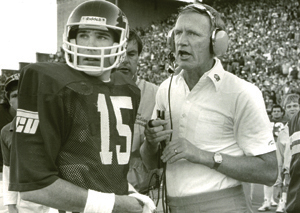
"She was the first person that I knew of that actually would take bench shots of the players and photos outside of the game, on the bus, on the airplane," Kennedy said. "I think people finally hooked on to the fact that that would be a pretty good thing to humanize the players."
In the 1970 Cotton Bowl, Kaye was nearly in the deliberations with James Street and Darrell Royal as the star quarterback and his coach decided to go for broke on fourth-and-2 with 2:26 remaining on the 10-yard line, with No. 1 Texas trailing Joe Theismann and No. 9 Notre Dame 17-14. Kaye got the shot, Street completed a pass to Cotton Speyrer to the goal line, and the Longhorns won a national title two plays later, as Billy Dale scored from the 1. Royal marveled at her work, calling it the greatest sports photograph he'd ever seen, and autographed it for Kaye: "Great shot, Linda." Street had a painting of it that then hung in his house. It stands alongside her Ryan photos as another iconic Texas photo.

Kaye accomplished all this before women were regularly accepted as sports photographers. She photographed the Cotton Bowl on assignment for the University of Texas, but the Dallas Cowboys still didn't allow women on the sidelines.
"She was a badass pioneer," said Frazier, who knew her when he worked at TCU. Roger said that was never something that she considered. She was just "a hustler," he said. She was an institution in Fort Worth, the photographer who didn't want her name on photos, but everyone knew by name.
Kaye wasn't the typical journalist. She wore her fandom on her sleeve, literally. At TCU, she wore all purple, even making her own custom-dyed purple kicks, and was an unabashed Rangers fan who sometimes even wore team swag while covering games, and would shake her head in disgust when things didn't go their way.
Former Texas general manager Tom Grieve said major leaguers, home and away, knew and liked her. She was a character, he said, sometimes grabbing a glove and fielding fungoes, or ground balls from coaches, with the team before games. She also got plenty of one-on-one time with players, shooting team headshots or photos for Blake, who at the time was the Rangers' director of media relations.
"The players, to a man, respected her professionalism, but at the same time she was able to accomplish something that can be elusive and that's becoming a friend of all the players," Grieve said. "She wasn't really trying to, it was just her way."
Kaye and Ryan, in particular, forged a quick bond.
"Nolan, he connected with Linda," Blake said. "His sons [Reid and Reese] both went to TCU. There was that connection too." Both Ryan sons played baseball for the Horned Frogs, and Kaye frequently photographed them, and would visit with Nolan in the stands.
Ryan would see her working and noted she needed more space for her photo equipment. So he sold her his own ride, a blue Lincoln Town Car, with a massive trunk.
He delivered it with an autograph on the rearview mirror. The car is long gone, but Roger, 81, still has the mirror. It reads:
To Linda, I'm glad you have my car. Nolan Ryan
IN THAT ERA, the Rangers didn't have much of a photo budget. Blake could afford to shoot only about 30 games a year, and would pick his spot for things like the 5,000th strikeout game or Ryan's 300th win. But obviously, any Ryan appearance could be magical, so it was luck of the draw.
That's how Kaye got the bloody lip and Ventura photos for herself. Blake said if a media organization or the Rangers had the rights to them, they wouldn't have been so commonly available to fans -- or Ryan.
In that Town Car trunk, Linda hauled around copies of her photos, hawking them to fans, another benefit of being self-employed. She'd even sell them in the stands at Rangers games from her spot in the third-base photographers' well before games and between innings.
"The Rangers did not own those photos," Blake said. "Nolan basically asked her, 'Can we have those photos? I want to sign them.'"
And Ryan churned out signed copy after signed copy. Blake said every year in spring training, the Rangers put up a sign saying "Nolan is signing today," or "Nolan isn't signing today." (Often, those signs got stolen too.)
But Blake said that was all by design. Ryan wanted his autograph to be a commodity. He didn't want it to be something people sold for a premium, and wanted anyone who wanted one to get one.
"When we were on the road, he would go out 15 or 20 minutes before the bus left at the hotel so he wouldn't hold up the bus signing," Blake said, adding that at spring training, he would sign for everyone in line. "The funny thing is he would recognize people that would come through twice. It was unbelievable. He would sign for two hours sometimes." Together, Kaye and Ryan flooded the market.
After Ryan retired, he resisted doctors' suggestions to surgically repair his ailing right wrist -- not from decades of throwing 100 mph fastballs. He said it was from years of signing autographs.
Kaye had surgery when she developed uterine cancer in 2002. It returned in 2006. She was given a year to live, and was in incredible pain. Still, she would go shoot assignments, with Roger holding her steady.
"In her last days, she told me, 'I thought I'd have at least 10 more years to take pictures,'" Roger said.
He said she had no idea how beloved she had become until the end, when TCU's then-chancellor, Victor Boschini, visited every day. The president of the United States, George W. Bush even called her in hospice to reminisce about all the times they had seen each other at the ballpark, chatting while Bush, then the Rangers' managing partner, was in the front row and Kaye was shooting the games. He apologized to her for never getting her a World Series title, and asked Roger to give her a kiss for him.
But there was one caller who outranked the president. "It was Nolan!" He called to offer his appreciation for documenting some of the most storied moments of his career, which meant everything to Kaye.
"He was her baseball hero," Roger said.
Kaye died on Oct. 7, 2007. She wore a purple TCU shirt and purple socks in her final hours, in a room filled with purple balloons and flowers, according to TCU Magazine.
Roger laments that she was around for all the lean years of the Rangers and the Horned Frogs, and was gone before the Rangers finally won a World Series, TCU won a Rose Bowl and went to the College Football Playoff National Championship. She donated her TCU archives and Horned Frogs memorabilia to the school, which has a Linda Kaye special collection in the university's library.
Ryan's legend helped the Rangers land a new stadium. He got a statue in Arlington and became the first player to wear the Rangers cap in the Hall of Fame. They're intertwined in photos on walls across Texas, and on Thursday, a huge crowd will show up to watch their Rangers and celebrate a memory they helped shape.
Grieve misses the fan who became a documentarian of history. He said in a perfect world, there's another outcome befitting her legacy.
"That ball would've hit Nolan, we would not have had the uniform washed and he would've handed it to Linda Kaye after the game and said, 'This is for our appreciation of what you've done for this team,'" Grieve said. "For the picture that you took, I want you to have this uniform."