

AUGUSTA, Ga. -- We're all going to tell our grandkids stories about Tiger Woods at the Masters someday.
About that 12-stroke victory as a 21-year-old phenom back in 1997. About the chip at the 16th hole eight years later that hung on the lip forever before miraculously dropping into the cup. Even about the time in 2013 that he hit the flagstick on 15, the ensuing result and subsequent penalty possibly robbing him of a fifth green jacket.
Of all the stories we'll tell them, though, of all the awe-inspiring Tiger tales from his extraordinary Masters career, only one will stand the test of time as the most unbelievable.
This one reveals less about Woods as a player than our collective obsession with his exploits.
The story is this: We legitimately used to ask ourselves before each Masters whether we'd select Tiger to win or the entire rest of the field. And more often than not, during those years, the majority would take Tiger.
We don't have to wait decades for this notion to seem completely far-fetched. It already does.
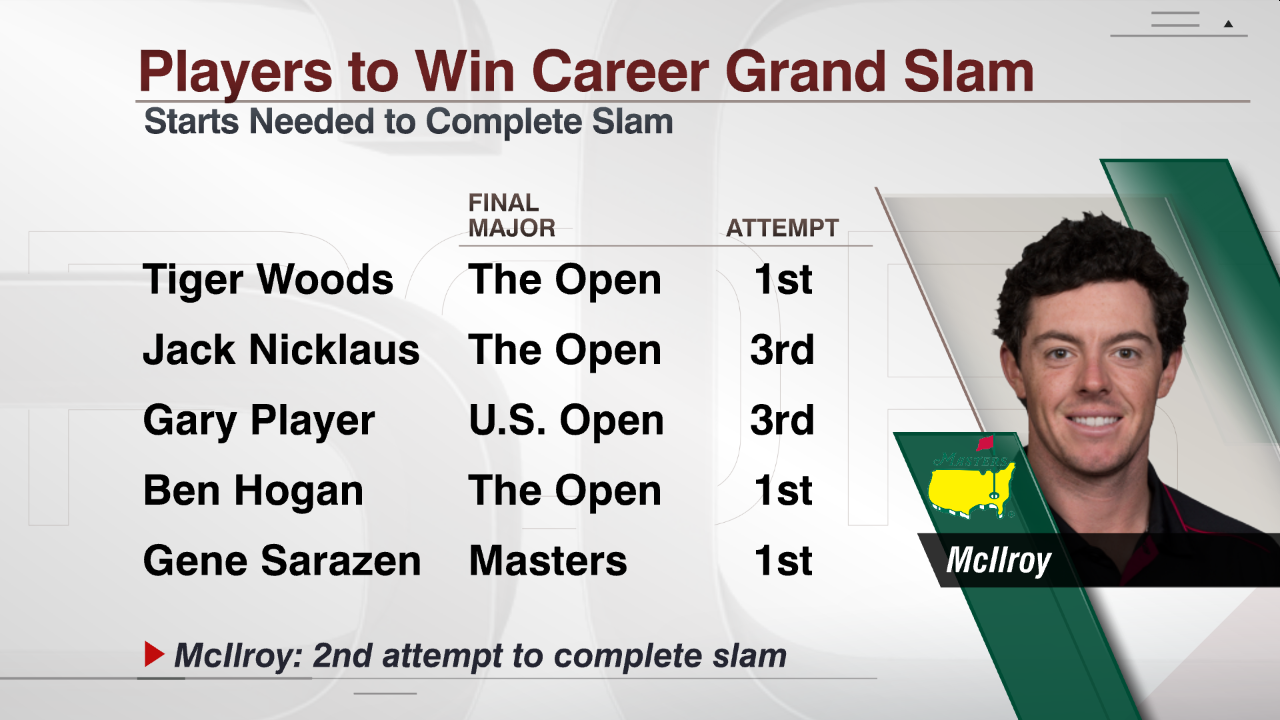
Entering this week's 80th edition of the Masters, oddsmakers have enlisted No. 1-ranked Jason Day as the favorite, but only slightly over defending champion Jordan Spieth and four-time major champion Rory McIlroy.

That triumvirate is followed closely by the likes of Adam Scott, Bubba Watson, Rickie Fowler, Phil Mickelson and Dustin Johnson, with plenty of others not much further back.
It's all part of a prevailing theme entering the first major of this year. Namely, it's anybody's ballgame.
"It is much different than the years Tiger dominated," McIlroy explained. "I don't know if we're going to see a 10-year stretch of golf like that in our lifetime. What he did in that time span was amazing. But I think golf is very lucky to have a younger generation coming through that can grow the game."
"I lived through the Tiger dominance," Scott said. "We all just felt at times we were playing for second, that's for sure. I think it's a different point in the game. I think it's going to be a while before, or ever, we see dominance like we saw from Tiger Woods. The game's changed even in the last six or seven years since Tiger won his last major championship in lots of different ways."
In the dozen years from 1997 through 2008, when Woods won all 14 of his major titles, 25 different players claimed those 48 majors. In the seven years since, 21 different players have combined to win 28 majors.
This might seem like a new era in the game, but the truth is that this is simply a regression to the norm. This is what professional golf was always meant to be: less domination from an individual figure and more outright parity at the top among so many stellar talents.
"I didn't like getting beat by Tiger all the time. I mean, it sucked," Day said with a laugh. "But as a fan, it was fantastic golf to watch. I mean, he did things that no one else could do. Hit shots around the greens, shots from way off the green, approaches. It was just amazing what he could do as an athlete in our sport. Changed the game of golf for the better."
It's an important point that Day makes, and one that shouldn't go unnoticed among either the general public or the players themselves.
It was Woods who opened the door for this current generation of top players to realize their potential. It was Woods who proved to them what was capable and how dominance could be achieved.
Now that dominance is of the collective variety rather than one player, his impact still rings true every week.
"Our generation is so competitive, and we enjoy and thrive off that competitiveness; we enjoy everyone having that pretty close competitive nature," Day said. "As a fan, it's great to not just be one person and that one person playing against the whole tour. It's great to see a bunch of fans just really cheering for their own guy and who is going to win that week."
"I was never a part of this tournament when you were worried about one guy," Spieth added. "Everyone felt it as a fan, right, when Tiger was a 3-to-2 favorite or whatever, something ridiculous. So you certainly knew it, but I was never here."
Woods isn't here this week, at least not as a competitor, missing the Masters due to injury for the second time in three years.
Some observers will bemoan this as the end of an era, as we transition into one in which there is no singular dominant player.
Really, though, that era ended years ago. It ended because the younger generation became superstars as Woods progressively aged, but that's too shallow a viewpoint.
That era ended because Woods showed them all what was possible when he was playing his best golf. He raised the bar for everyone who came after him. He's responsible for the current state of the game, with so many brilliant performers believed to be contenders for this week's Masters.
As McIlroy spoke of Woods' impact and his own fellow group of superstars, the Northern Irishman concluded his point with one final statement that summarized it all so well.
"Golf," he said, "is in a good spot right now."