
The referees are sorry; they really are. According to the Premier League's official statement, the reason VAR overlooked an extremely offside Enzo Fernández on the goal that decided last month's Manchester derby was that officials were simply too busy watching Erling Haaland.
And honestly, who could blame them? The man is captivating in slo-mo.
As Josko Gvardiol scooted up the opposite side of the box, Haaland adjusted each stride to stay perfectly level with the ball: a half-step with his left foot, then a lunge with his right, always landing precisely where he needed to be. When Gvardiol curled the cross around Patrick Dorgu some 30 yards away, Haaland was, as best modern technology can measure, 3 centimeters behind the line of Dorgu's big toe.
Attackers with a special knack for staying onside often don't get as much love as they deserve. The most famous was probably AC Milan striker Filippo Inzaghi, whose high-wire style of play inspired Manchester United boss Sir Alex Ferguson to joke that the "lad must have been born offside."
Inzaghi took that personally. "Thankfully I was born a meter onside," he shot back, "otherwise I wouldn't have scored most of my goals."
Is it possible to measure who's really good or bad at staying onside -- and how much that skill is worth?
For an ability that can decide games or even titles, it's a little strange that we've never had an objective way to separate the Enzos and Haalands of the world. We obsess over players' goals and expected goals, but we rarely stop to wonder how many of those chances come from simply knowing how to stay on the right side of an invisible line.
One easy way to come at this missing measurement might be to count up a player's offside flags, but knowing that Haaland has been caught offside 25 times in the Premier League doesn't really tell us whether he's better or worse at it than Crystal Palace winger Ismaïla Sarr, who has the same number. Stats that aim to measure a skill need to account for the different levels of opportunity players have to do that thing.
So OK, fine, what about comparing offside flags to goals scored?
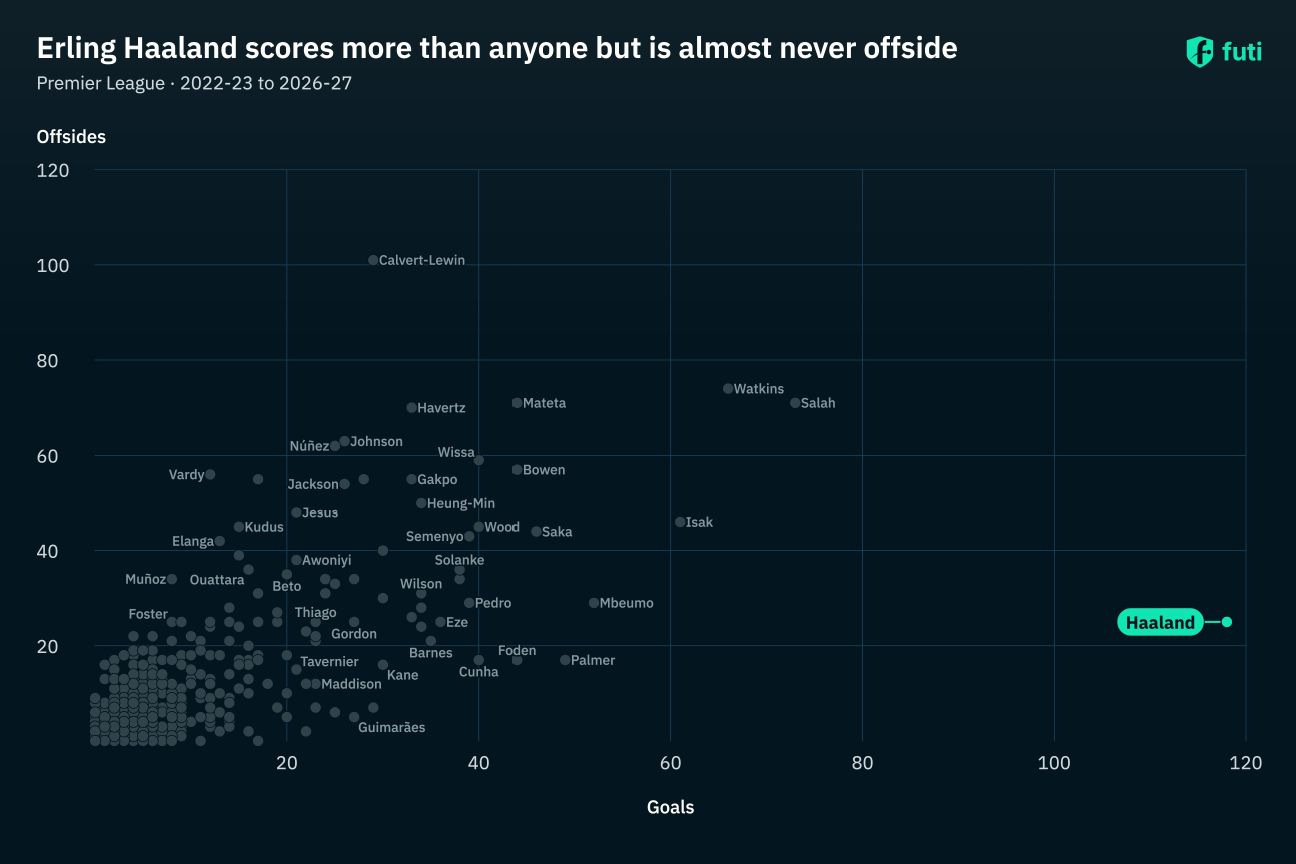
Now we might be getting somewhere. It's not exactly news that Haaland piles up goals, but it's pretty mind-boggling to see that he's put up those numbers while being offside slightly less than Nottingham Forest wing back Daniel Muñoz.
What about the rest of the league, though? It's tough to say just from eyeballing this plot whether Palace's Jean-Philippe Mateta or Newcastle's Yoane Wissa is better at curving his runs. Trying to use a simple ratio of flags per goal doesn't really work, either. Midfielder Jorginho scored 21 goals for Chelsea and Arsenal while being offside exactly zero times, causing a calculator error that sounds impressive until you try to remember the last time you saw the flag go up on a penalty.
A better way to measure onside skill is to use detailed data on every touch of the ball. Without access to the skeletal data that generates those department store mannequin VAR animations, it's impossible to actually measure the nuances of a striker's run, but a relatively simple on-ball model can look at each pass in context and predict how likely it was to be. If you'll forgive a terrible name: meet xOffside.
Most of the information that an expected offside model cares about turns out to be more or less what you'd expect. Longer, faster passes are much more likely to draw a flag than short ones. Chipped or lofted balls are offside more often than similar passes on the ground, probably because they're more likely to be played under pressure or without a clear view of the runner. The angle is important, too: a ball straight ahead is more likely to be caught by an offside trap than one played on a diagonal, especially if it's aimed outward from the middle of the pitch.
Ball location alone doesn't tell you a whole lot about what's happening on the pitch, so I added phase of play data from the new stats app futi, which I co-created. Giving the model tactical context helps it predict the offside risk. For example, a long forward pass in the build-up is more than three times as likely to be offside as one with the same start and end points during the progression phase, after the defense has dropped back to midfield.
Another important factor in xOffside is who's doing the defending. Although we tend to use the terms interchangeably, a high line isn't really the same as an offside trap, which is a specific tactic where defenders move against the grain of play. One manager's high center backs might drop below the center circle to follow attacking runs, while another's will step up instead -- Brazilians once called it a "donkey line" -- because of how stupid an offside trap can look when it doesn't work.
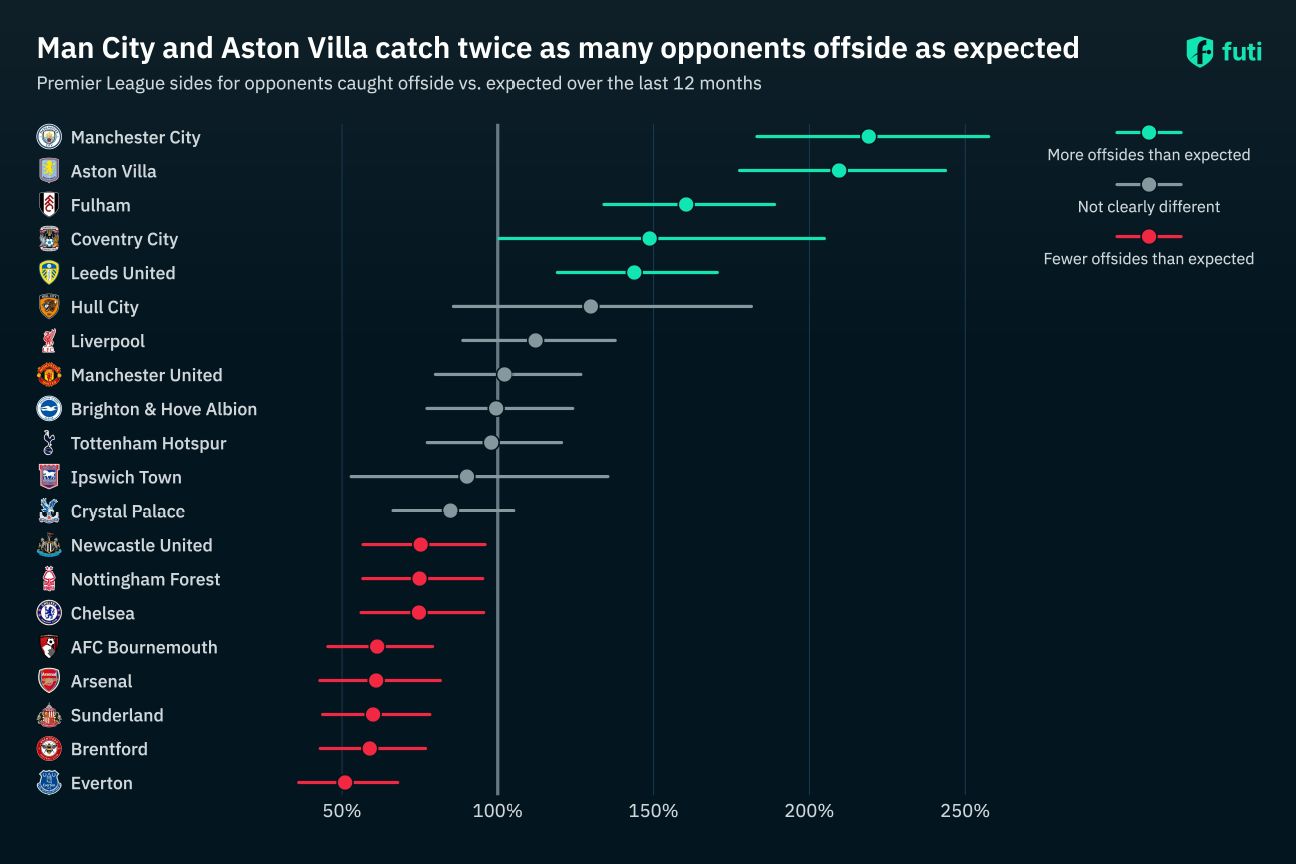
Unai Emery's Aston Villa love the offside trap. So did Pep Guardiola's Man City. It's an old staple of ball-dominant sides that want to compress the space they need to defend when they lose possession. But an offside trap isn't the only way to win: last season's Arsenal played elite defense high up the pitch while catching opponents offside about 40% less often than the model would expect based on the passes they faced.
You'll find the reigning champs toward the bottom of the offside trap rankings below, all the way down by ... Sunderland.
Given enough information about when, how and against which defense a pass was played, xOffside can do a pretty good job of predicting flags in a season the model has never seen. But turning that into player ratings still needs one more bit of information: the receiver's playing position. One tried and true trick for beating the offside line is to make a run from deep while somebody else distracts the center backs, which puts the strikers doing the distracting at a disadvantage against wingers and attacking midfielders.
Ready to be shocked? Even after the position adjustment, Haaland doesn't quite come out on top.
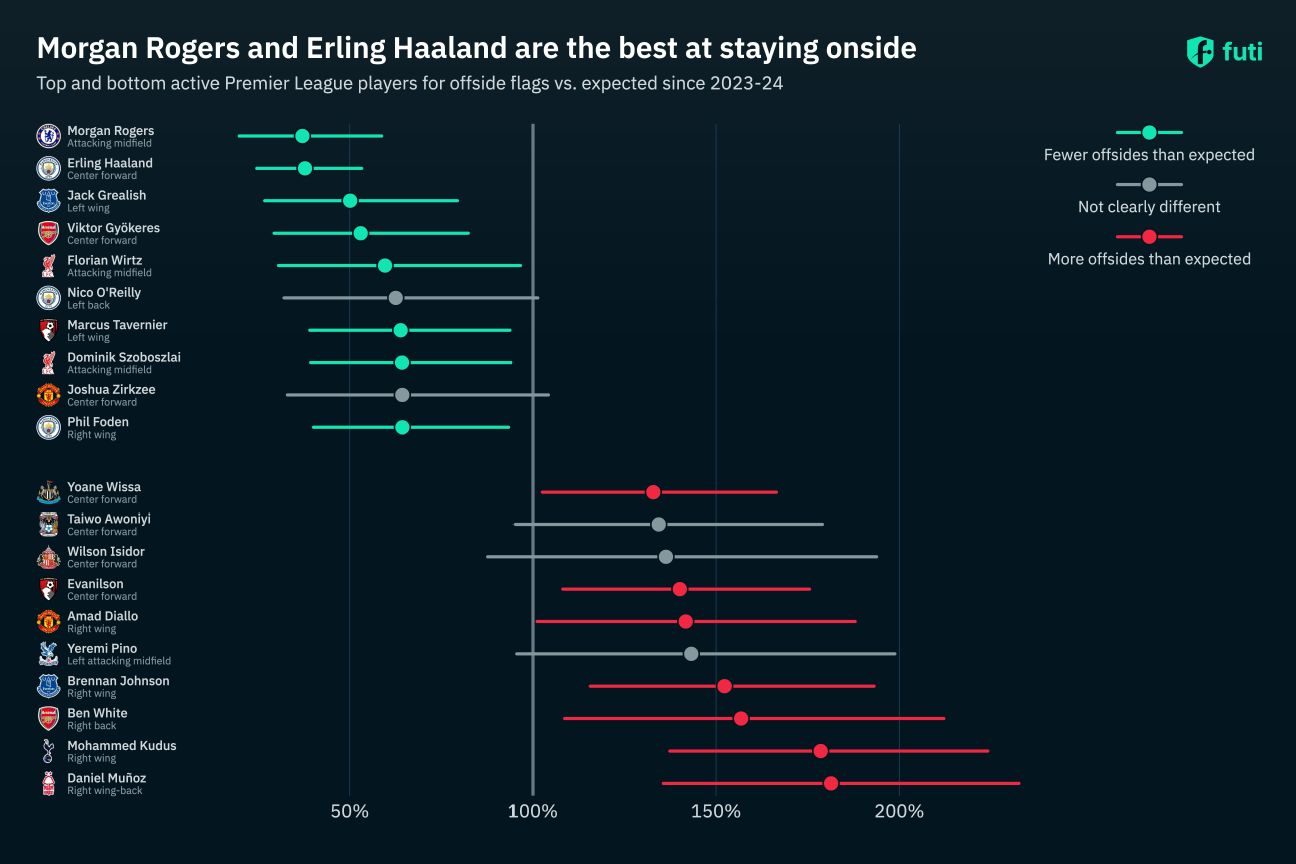
The Premier League's best active player at staying onside -- by a whisker, appropriately enough -- is former Aston Villa and now-Chelsea forward Morgan Rogers, who has been flagged just twice from open play passes over the last three-plus seasons compared to 18.3 expected offside calls. There's a lot of uncertainty in that small a sample, but Rogers and Haaland are joined by at least seven other players who we can be reasonably sure are good at staying onside.
On the low end, only nine players are clearly offside more than average and two of the worst offenders happen to have played together at Tottenham, which probably explains a lot. Leeds United's Dominic Calvert-Lewin and Mateta don't quite make the bottom 10 chart by offside rate -- thank Wissa and Coventry City's Taiwo Awoniyi for sparing their blushes -- but they've had enough reps to leave some daylight between their confidence interval and the wrong side of the line.
The interesting thing is that none of this seems to matter to the scoreline as much as you might expect.
Tottenham's Mohammed Kudus has been offside 38 times to Rogers' two from almost exactly the same number of open play expected flags, but if you crunch the numbers on their "true" skill level, the number of risky passes each receives and how likely those plays are to actually lead to goals, the difference between the best and worst players in the league by offside rate works out to only about half a goal a season. Even Haaland, who combines freakish onside skill with a high volume of risky passes, is expected to add just 0.63 goals to his Golden Boot campaign by toeing the line.
Seen from another angle, though -- how about we step over to the VAR monitor and roll it back? -- maybe that number isn't low at all.
Goals are expensive. Over the last decade, each extra unit of goal difference has cost a Premier League club about 2.3% of its wage bill. That means a big spender like Man City, who according to Deloitte have a wage bill over $500 million, would expect to pay $12 million just to add a single goal to their season's difference. For City to get the equivalent of $7.5 million per year from one very particular skill by a single player doesn't sound like such a bad return, especially when it comes packaged with other skills like "treating center backs like bowling pins" and "doing karate kick goals in mid-air."
Of course, there's a lot our simple xOffside model can't see, of course. It can't credit players for the space they create when defenders drop in to give them special attention. It can't appreciate all the little tricks that go into beating the offside line: the blind side drifts, the double movements and curved runs, that thing where a striker will hang around behind the center backs just to get a few yards' head start when a teammate breaks up the wing.
What it can do, though, is help us start to value a skill that's too often invisible except in replays.
"The worst thing I know is going offside, because then you've got no chance of scoring a goal," Haaland once said. "But if you're onside but a bit further away, then you've got a chance."